
Corporate Governance
- Basic Policy
- Compliance with the Corporate Governance Code
- Corporate Governance Structure
- Board of Directors Skills Matrix
- Overview of the policies for determination of remuneration, etc.
- Constructive Dialogue with Shareholders
- Cross-shareholdings
- Takeover Defense Measures
- Messages from external directors/Dialogue opportunities
Based on OUR PHILOSOPHY (TIS INTEC Group Philosophy) and Group Vision, we have formulated basic corporate governance policies aimed at improving the Group’s corporate value over the medium and long terms. We are working constantly to enhance corporate governance.
* PDF files must be viewed with Adobe Reader
Basic Policy
TISI will constantly strive to achieve the highest level of corporate governance and will work to maintain and further enhance its approaches to corporate governance.
Management believes that the key to good corporate governance is to ensure transparency and fairness in decision-making processes, make full and effective use of management resources, and raise the integrity of management practices through swift and accurate assessment of situations, from the viewpoint of promoting sustainable corporate growth and boosting medium- and long-term corporate value. Accordingly, management at the Company is committed to upholding good corporate governance in line with the following basic principles.
- To respect the rights of shareholders and to ensure equality.
- To consider the interests of stakeholders, including shareholders, and work with stakeholders in an appropriate manner to achieve stated goals.
- To disclose corporate information appropriately and ensure transparency.
- To engage in constructive dialogue with shareholders based on a medium- to long-term investment perspective.
Pursuant to a resolution passed at the 18th Annual General Meeting of Shareholders on June 23, 2026, the Company transitioned to a company with an audit and supervisory committee. The transition will reinforce corporate governance practices from a global perspective and ensure that the Company meets the expectations of domestic and international stakeholders.
Compliance with the Corporate Governance Code
TISI complies with all principles of the Corporate Governance Code.
The status of the Company’s responses to each principle of the Corporate Governance Code is described in the Corporate Governance Report.
Corporate Governance Structure
| Form of Organization | Company with an Audit and Supervisory Committee |
|---|---|
| Chairman of the Board | Chairman(Non-executive director) |
| Number of Directors | 13 (including 6 External Directors) Directors (excluding Directors who are Audit and Supervisory Committee Members): 9 (including 3 External Directors) Directors who are Audit and Supervisory Committee Members :4 (including 3 External Directors) |
| Director's Term of Office | Directors (excluding Directors who are Audit and Supervisory Committee Members) :1 year Directors who are Audit and Supervisory Committee Members :2 years |
Reason for Selection of Current Corporate Governance Organization
To enhance corporate governance from a global perspective, the Company has adopted the corporate governance system of a Company with an Audit and Supervisory Committee, through which the Company ensures the clarification of the division of roles between oversight and execution, strengthens the oversight function of the Board of Directors, delegates authority to business execution functions, and expedites decision-making.
Organizational Chart
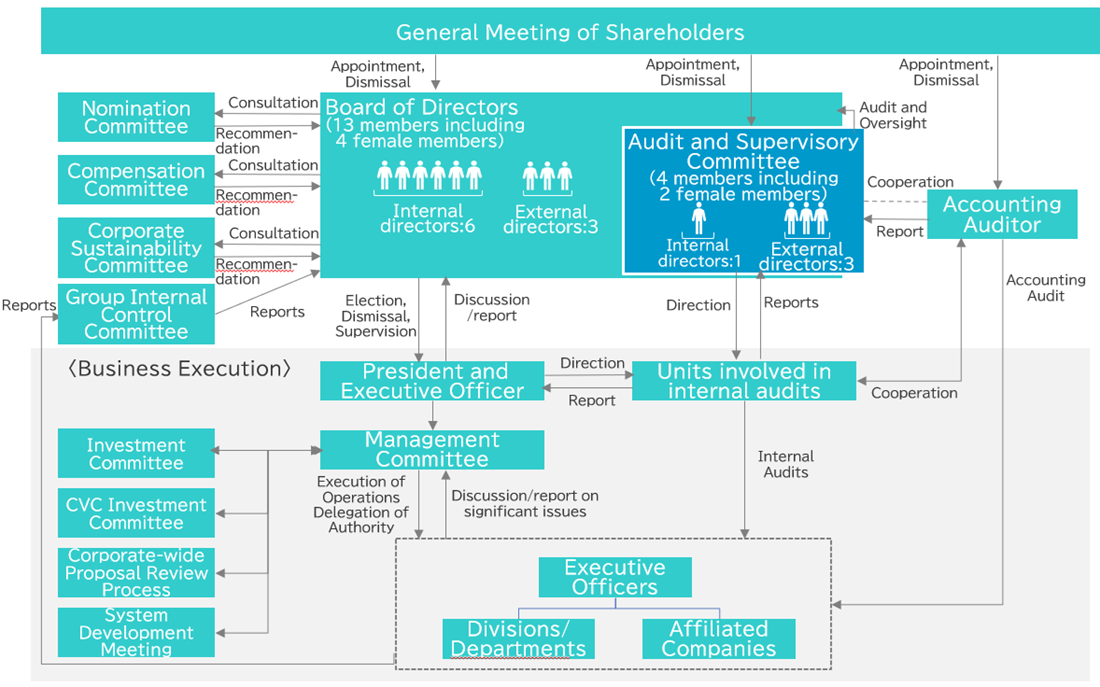
| Directors and Board of Directors | As stipulated in its Articles of Incorporation, the Company's Board of Directors will comprise at least three and no more than 15 directors, and to strengthen the supervisory functions of the Board of Directors, a policy has been established that one-third or more of the directors must be independent external directors. At present, six independent external directors have been appointed. In principle, the Board of Directors meets once a month, with additional extraordinary meetings and meetings to exchange opinions held as necessary to enable Directors to make swift and flexible decisions. TISI holds an information meeting once a year to present management direction as well as meetings ahead of Board of Directors' meetings—in principle, once a month—to give external directors sufficient background information to participate in discussions. In addition, the Company organizes study sessions with experts—in-house and external—and arranges visits to local Group facilities and offices. TISI also provides support to ensure smooth and proactive discussions at Board of Directors meetings, including by holding informal meetings between external directors and the President, and exclusively among external directors. |
|---|---|
| Audit and Supervisory Committee | The Audit and Supervisory Committee comprises four directors who serve as members of the committee, three of whom are external directors. They audit the execution of duties by directors in accordance with audit policies established by the committee. The committee maintains close ties with Ernst & Young ShinNihon LLC, the Company’s contracted accounting auditor, through receipt of annual audit plans from the firm and reports on the results of audits by the firm as well as through regular information-sharing and exchange of opinions. In addition, the committee receives reports on the results of audits conducted by internal audit departments, and seeks to enhance the effectiveness of audits through close cooperation with these departments, by opinion exchange and information-sharing as well as by providing specific instructions to these departments. |
| Nomination Committee | The Nomination Committee was established as advisory bodies to the Board of Directors to ensure objectivity and transparency in decision-making processes pursuant to appointment of directors and to strengthen the corporate governance structure. The independent outside director chairs the committee, with the majority of members, including the committee chair, being independent outside directors. |
| Compensation Committee | The Compensation Committee was established as advisory bodies to the Board of Directors to ensure objectivity and transparency in decision-making processes pursuant to compensation of directors and to strengthen the corporate governance structure. The independent outside director chairs the committee, with the majority of members, including the committee chair, being independent outside directors. |
| Group Internal Control Committee | The Group Internal Control Committee is charged with promoting various measures to maintain and improve the internal controls of the Company and its subsidiaries, to evaluate the operational status of the internal control systems and to recommend any corrective action to be taken to the Board of Directors, if necessary. The committee, chaired by the TISI President, comprises standing directors, standing Audit and Supervisory Committee members, persons responsible for the internal control management, and any person whose attendance is authorized by the committee. |
| Corporate Sustainability Committee | To implement sustainability management, we will identify trends, discuss sustainability-related issues, and indicate the direction and targets of our response. In accordance with these directions and targets, corporate and business department plan and promote measures, and their planning or progress are deliberated by the Management Committee and overseen by the Board of Directors as appropriate. The committee, chaired by the TISI President, Directors, Division Manager of corporate planning division, Department Manager of corporate planning Dept, and any person whose attendance is authorized by the committee. |
| Management Committee | The Company has established the Management Committee to deliberate and report on important matters affecting business execution at the Company and the Group as a whole. |
| Investment Committee | The Investment Committee was established to verify/advise on plans for investment projects, monitor ongoing projects and assess whether to continue them with the aim of minimizing related risks and earning higher returns on investments. |
| CVC Investment Committee | The Company makes corporate venture capital (CVC) investments and enhances alignment with venture capital companies in the form of open innovation in order to (1) create new business, (2) expand existing businesses, and (3) promote business collaboration with customers. For such investments, the CVC Investment Committee decides whether or not to execute an investment and monitors the executed investment. |
| Corporate-wide Proposal Review Process | For large-scale projects to be addressed by the Group as a whole, the Corporate-wide Proposal Review Process was implemented to review drafts prior to actual proposals to customers, in order to detect and reduce risks as early as possible. |
| System Development Meeting | System Development Meetings are held to identify potential risk factors in large-scale projects to be undertaken by the Group as a whole, to develop measures to prepare for risks, to resolve issues before they materialize, and to terminate any project with losses. |
Executive Officer System
The Company has adopted an executive officer system and enables the Board of Directors to delegate authority for important decisions regarding the execution of operations to directors, in order to clarify functions and responsibilities related to management and the execution of business operations and to accelerate and enhance the efficiency of decision-making. Directors delegate business execution to Executive Officers, and these Executive Officers provide specific direction, orders, and supervision to each business unit head.
Viewpoint regarding Composition of Board of Directors
The Board of Directors shall comprise no more than 15 directors, at least one-third of whom shall be independent external directors. The Board of Directors recognizes its fiduciary responsibility toward shareholders, formulates management strategy and management plans, makes decisions on other important matters and supervises the execution of Company business in accordance with relevant laws, the Articles of Incorporation and rules of the Company, and bears a responsibility to ensure sustainable growth and higher corporate value over the medium to long term. Directors shall, in accordance with selection criteria established by the Company, consider the candidacy of and ultimately nominate individuals who possess extensive experience, sharp insight and a high level of specialization well suited to the role of director, giving thought to gender, internationality, career, age and other aspects of diversity and in order to contribute to the sustainable growth of the Company as well as the enhancement of its medium- to long-term corporate value, and taking into account recommendations by the Nomination Committee, which comprises a number of executives, the majority of whom are independent external directors.
Evaluation of the Effectiveness of the Board of Directors (Year ended March 31, 2026)
1. Process of evaluation
For its sustainable growth and improvement of corporate value, TISI has evaluated the effectiveness of the Board of Directors each fiscal year with the aim of identifying issues and areas for improvement and improving the Board’s effectiveness.
For evaluation, all Directors and Audit & Supervisory Board members were given a questionnaire to be submitted. The questionnaire asked them to conduct a comprehensive self-evaluation of the priority themes for further enhanced corporate governance as well as the operation of the Board of Directors. Individual interviews were also conducted, and the Board of Directors held discussions based on the results of those interviews. Note that TISI conducted this effectiveness evaluation and discussed action policies/suggestions to improve effectiveness going forward based on advice and verification by external experts.
2. Coverage of evaluation
The fiscal 2026 evaluation was conducted with a focus on the status of initiatives for the priority themes for further enhanced corporate governance, in addition to the operation of the Board of Directors in the fiscal 2026.
-
(1) Operation of the Board of Directors
From the perspective of further enhancing monitoring, we confirmed the appropriateness of the viewpoint and the frequency of selecting and monitoring agenda items, the frequency and duration of meetings, the explanation about meeting agenda, materials provided, the amount of information contained, etc. -
(2) Priority themes for further enhanced corporate governance
We confirmed the appropriateness and sufficiency for the following themes:- Board of Directors' supervisory function
- Expected roles for Directors
- Delegation of authority to execution side
- Composition of the Board of Directors
- Ideal state and functioning of advisory committees (Nomination and Remuneration)
- Coordination between the Board of Directors and auditing bodies
- Dialogue with shareholders, and other themes.
3.Initiatives for the challenges identified in the previous fiscal year
The Board of Directors of the Company set two issues identified in the previous fiscal year, “advancement of operation of the Board of Directors” and “strengthening of the monitoring board function,” as priority issues, and implemented initiatives to address these.
-
(1) Advancement of operation of the Board of Directors
- Through the formulation of an annual agenda and discussions on important themes, TISI established the operation of monitoring for management policies, the medium-term management plan, human resources, etc. and also held exchanges of opinions at the Board of Directors meetings on important themes such as AI and M&A.
-
(2) Strengthening of the monitoring board function
- As an enhancement of the monitoring board function, including strengthening the monitoring of key strategies based on the medium-term management plan, advancing nomination and remuneration governance, and strengthening the business execution structure and group governance, consideration was given in the Corporate Governance Enhancement Project, primarily composed of external directors. Based on the results of the consideration, the Board of Directors resolved to change the organizational design, specifically the policy for the transition to a Company with an Audit and Supervisory Committee.
4. Results of the evaluation
Based on the results of our self-evaluation, etc., we have determined that the effectiveness of the Board of Directors of the Company is generally ensured, and that steady improvements have also been made in its operation. Meanwhile, the Board of Directors has recognized the need to continuously work on the evolution of the monitoring model for the Company’s sustainable growth and medium- to long-term corporate value improvement. In particular, with regard to the monitoring of execution at the implementation phase of the medium- to long-term strategy, the Board of Directors has evaluated that there is a need for further advancement, such as clarifying monitoring points from the supervisory side to the execution side in order to realize the strategy.
-
(1) Evaluation for the operation of the Board of Directors
- As for running the Board of Directors meetings, clarifying the code of conduct and setting the agenda for the Board meeting have helped to align the perspective of the Board and stimulate discussion.
- On the other hand, we have recognized from the evaluation that there is room for improvement from the viewpoint of regular monitoring of key strategies (business portfolio, M&A, ERM, human resources, finances, etc.) based on the medium-term management plan, which is the basic policy of the Company.
- As for the status of examination toward the formulation of the next medium-term management plan, it is expected to be reported to the Board of Directors as appropriate, and it is expected that thorough discussions will be held. Furthermore, regarding the global strategy, we have recognized that there is a need for continuous strategic discussions in light of the changes in the business environment and the progress status, and that it is important for the Board of Directors to hold timely and thorough discussions on rapidly changing themes such as the use of AI.
-
(2) Evaluation for the priority themes for enhanced corporate governance
- We have recognized the need to further strengthen the operation of the monitoring board following the changes in the organizational design, with regard to strengthening governance across the Group regarding various types of capital, including human capital and financial capital, and considering the composition of the Board of Directors (in terms of the balance of internal and external Directors and their diversity) to be more suitable for monitoring them.
5. Future responses based on evaluation
In light of the results of the evaluation, TISI has classified its initiatives addressing the operation of the Board of Directors and priority themes for enhanced corporate governance into short-term category and medium- to long-term category, and will implement them step by step from fiscal 2027 on an ongoing basis.
-
(1) Short-term initiatives
In fiscal 2027, we will improve the management of the Board of Directors with regard to the following themes:- For the formulation of the next medium-term management plan, report the execution proposals regarding important management strategies, such as the company-wide strategy, to the Board of Directors in a timely and appropriate manner, and conduct thorough discussions
- Enhance the content of discussions in Management Committee meetings from the perspective of medium- to long-term growth and corporate value enhancement, and improve the effectiveness of the Board of Directors’ monitoring function over business execution by sharing opinions (especially objections and opposing opinions) in Management Committee meetings with the Board of Directors
- Enhance reporting that focuses on the issues for the Board of Directors to review, and the assumptions and risks necessary for decision-making
- Provide external directors with ongoing information on industry technology trends, competitive environment, regulatory trends, etc.
-
(2) Medium- to long-term initiatives
TISI will continue to consider the following themes, aiming at further improving the effectiveness of the Board of Directors.- Further strengthen the monitoring board function, along with the transition to a Company with an Audit and Supervisory Committee
- Continuously consider board succession planning and review the Board of Directors composition and skills matrix based on the same
- Further enhance the effectiveness of nomination and remuneration governance (verification and enhancement of executive succession)
- Strengthening of business execution structure (further strengthening of governance across the Group)
Policy and Procedures for Election, dismissal, and Nomination of Directors, etc.
In nominating Directors and other officer positions, the Company will nominate persons with abundant experience, a high level of insight and advanced specialization based on the election criteria established by the Company that make them suitable as directors in order to realize effective corporate governance and contribute to the sustainable growth of the Company as well as the enhancement of its medium- to long-term corporate value while also considering aspects of diversity such as gender, internationality, career and age. When nominating candidates for directors, the Board of Directors will deliberate on the matter after consulting with the Nomination Committee, a voluntary advisory body chaired by an independent external director and composed of several directors, with the majority of members being independent external directors—and for candidates for directors who are Audit and Supervisory Committee Members, after also obtaining the consent of the Audit and Supervisory Committee. If a situation arises that requires a core member of the executive team to be removed from office, the Board of Directors will make a proposal for dismissal. The dismissal of a director will be undertaken in accordance with the Companies Act and other relevant rules and regulations.
Reason for Election of Directors
- Directors (Excluding Directors Who Are Audit and Supervisory Committee Members)
| Toru Kuwano | After assuming the office of President and Representative Director of the Group company, Toru Kuwano was appointed as a Director of the Company in June 2013 and President and Representative Director in June 2016. Since April 2021, he has assumed the office of Chairman and Director of the Company. He has a wealth of experience and deep knowledge gained over many years about the Company’s and the Group’s business, as well as in business administration. Furthermore, since April 2021, he has served as Chairman of the Board of Directors in a non-executive director position, demonstrating leadership in ensuring fair management oversight and driving efforts to strengthen our corporate governance structure. As a result, he has made a significant contribution to the Company’s sustainable growth and the enhancement of its corporate value over the medium to long term. He was appointed as a Director, since he is highly expected to continue leading discussions to ensure that the Board of Directors’ supervisory functions are fully exercised, and to play a key role in significant decision-making for the Group as well as in the administration and oversight of business management. |
|---|---|
| Yasushi Okamoto | Yasushi Okamoto served as Senior Managing Executive Officer and Division Manager of the planning and development department of industrial systems from July 2016, after having been engaged in corporate business in the corporate planning department of the Company for many years. Subsequently, he assumed the post of Director in June 2018, and has been leading the Company as President and Representative Director since April 2021. Leveraging the experience and insights he has accumulated to date, he can demonstrate leadership in further driving the Group’s sustainable growth and enhancing its corporate value by ensuring the steady execution of the current Medium-Term Management Plan (2024–2026) and creating synergies through the integration of management resources following the merger with INTEC Inc. In addition, he is highly expected to contribute to significant decision-making for the Group as well as to the oversight of business management. Therefore, he was appointed as a Director. |
| Shinichi Horiguchi | Shinichi Horiguchi has been engaged in the finance/credit card business for many years, and has served as General Manager of the financial systems planning and development department for financial systems as Managing Executive Officer of the Company since April 2017. Furthermore, since joining the Company’s Board of Directors in June 2023 and assuming the position of Representative Director, Executive Vice President in April 2024, he has been in charge of corporate departments and supervised company-wide corporate management functions. He can leverage the specialized experience and insights he has accumulated to date to demonstrate leadership in driving the execution of the current Medium-Term Management Plan (2024-2026). He was appointed as a Director since he is highly expected to fulfill the duties of significant decision-making for the Group and oversight of business management as a member of the executive team. |
| Shuzo Hikida | Shuzo Hikida has been engaged in the creation of strategic informatization directly connected to business strategy at top-class companies in the industry at INTEC Inc., one of our major Group companies, to establish the revenue base in the network & outsourcing business operation and create new services. Furthermore, he was appointed Director and Executive Vice President of INTEC Inc. in April 2023 and became a Director of the Company in June 2023. Since April 2024, he has assumed the role of President and Representative Director of INTEC Inc., taking charge of its management. Leveraging his experience and track record to date, he can contribute to the advancement of the current Medium-Term Management Plan (2024–2026) and to the creation of synergies through the integration of management resources following the merger with INTEC Inc. as well as to the further enhancement of the Group’s corporate value. In addition, he is expected to play a significant role in making decisions on important matters and overseeing business management. Therefore, he was appointed as a Director. |
| Akira Makado | Akira Makado has spent many years working in corporate business such as finance and corporate planning departments at INTEC Inc., one of major Group companies, and possesses extensive experience and knowledge in financing and asset management. In April 2023, he was appointed as Director and Executive Vice President of INTEC Inc., and in April 2024, he became Representative Director and Executive Vice President. He plays a key role in corporate governance, overseeing INTEC Inc.’s entire corporate department. He was appointed as Director of the Company in June 2025. He was appointed as a Director, since he is highly expected to contribute to the promotion of the current Medium-Term Management Plan (2024-2026) as well as to the further enhancement of the Group’s corporate value, and to play a sufficient role in decision-making on significant matters and overseeing management operations drawing on the experience he has gained so far. |
| Kiyotaka Nakamura | After assuming the position of Executive Officer, Kiyotaka Nakamura was involved in corporate operations and the payment business in the corporate planning department. As Managing Executive Officer since April 2018 and Senior Managing Executive Officer since April 2021, he has contributed to the business restructuring of the global business, with a focus on business expansion in the Offering Service Business. Furthermore, since his appointment as a Director of the Company in June 2025, he has been actively leveraging his extensive experience to drive initiatives aimed at further enhancing corporate value and expanding our business in line with the current Medium-Term Management Plan (2024–2026). He was appointed as a Director, since he is highly expected to continue to fulfill the duties of significant decision-making for the Group as well as the oversight of business management. |
| Junko Sunaga | Junko Sunaga has spent many years working in the semiconductor business, centered on mobile phones, and in April 1997 she joined the Japan arm of Qualcomm (USA), a leading company in the mobile communications industry, as its first employee. Since April 2018, she has been President and Representative Director of Qualcomm Japan, Inc., where she has achieved successful results in expanding the semiconductor business in Japan. She is expected to provide advice and recommendations from an independent perspective by utilizing these experiences and expertise in the Company’s management to ensure that the decisions to be made by the Board of Directors will be reasonable and appropriate. Additionally, she serves as chair of the Nomination and Compensation Committees, which are voluntary advisory bodies to the Board of Directors. She was appointed as an External Director, since we believe she continues to contribute to enhancing corporate value and strengthening corporate governance. |
| Mitsuhiro Furusawa | Mitsuhiro Furusawa, having experienced being Vice-Minister of Finance for International Affairs and Deputy Managing Director of the International Monetary Fund (IMF), has broad insight into fiscal and monetary policy as a government official, and a global perspective gained as a senior executive at an international organization. We expect him to contribute to the enhancement of corporate governance of the Company by giving advice and suggestions from an independent perspective to ensure that the decisions to be made by the Board of Directors will be reasonable and appropriate. Furthermore, as a member of the Nomination and Compensation Committees, which are voluntary advisory bodies to the Board of Directors, he draws on his extensive experience and deep insight to offer objective observations and advice. Moreover, although he has not participated in corporate management in any manner other than as an external officer, he was appointed as an External Director, as it is considered that he will be able to utilize his extensive experience and knowledge to appropriately perform the duties of an External Director, thereby improving the Company’s corporate value and deepening and expanding global management. |
| Naoko Iwasaki | Naoko Iwasaki holds a PhD in Global Information and Telecommunication Studies and possesses academic and policy expertise regarding the revitalization of an aging society through the use of ICT. As overseer of the APEC Project on Smart Silver Innovation, she promotes research on aging-related issues and the use of digital technology from a global perspective. Additionally, as President of the International Academy of CIO Japan, she is involved in formulating digital policy recommendations and contributes to solving social issues through her diverse networks. This expertise aligns closely with the social issues prioritized in the current Medium-Term Management Plan 2024–2026, such as “urban concentration/rural decline” and “health concerns.” She was appointed as an External Director, since she is highly expected to contribute to enhancing the corporate value of the Company. |
- Directors Who Are Audit and Supervisory Committee Members
| Hideki Kishimoto | Hideki Kishimoto has experience in global management through his work in the finance sector promoting business overseas, and also has extensive experience and broad insight into corporate governance as head of compliance divisions. Since assuming the position of full-time Audit & Supervisory Board Member of the Company in June 2024, he has contributed to the enhancement of the Group’s governance structure in line with its globalization by leveraging the experience and insight gained throughout his career. We believe he will continue to fully exercise his role in providing effective and impartial audit and supervision of the executive duties performed by the Company’s Directors, and have therefore appointed him as a Director who is an Audit and Supervisory Committee Member. |
|---|---|
| Yukio Ono | Yukio Ono is a licensed certified public accountant. His expertise and knowledge in the field of finance and accounting and many years of experience in corporate audit are beneficial to the Company in strengthening the audit system of the Company. Furthermore, as an External Audit & Supervisory Board Member, he has contributed to strengthening the Group’s governance structure through his audit work from an independent standpoint, and we expect him to continue playing a role in strengthening governance based on his advanced expertise in corporate auditing. Moreover, although he has not participated in corporate management in any manner other than as an external officer, he was appointed as an External Director who is an Audit and Supervisory Committee Member, as he is considered to appropriately audit and supervise the execution of duties by the Company’s Directors from an objective standpoint for the above credentials. |
| Akiko Yamakawa | Akiko Yamakawa is a licensed attorney with extensive experience and expertise in labor and employment matters, including litigation related to employment disputes at global companies. Furthermore, through her external activities, such as initiatives to support women’s advancement, she has provided effective audit function from an objective and professional standpoint regarding the Company’s global business operations and human resources strategy. We expect her to continue to play a role in enhancing governance based on her advanced expertise. Additionally, as a member of the Nomination and Compensation Committees, which are voluntary advisory bodies to the Board of Directors, she leverages her extensive experience and deep insight to provide objective observations and advice. Moreover, although she has not participated in corporate management in any manner other than as an external officer, she was appointed as an External Director who is an Audit and Supervisory Committee Member, as she is considered to appropriately audit and supervise the execution of duties by the Company’s Directors from an objective standpoint for the above credentials. |
| Hiroko Kudo | Hiroko Kudo has deep insight into domestic and international administrative and financial affairs and a PhD in public policy, and has been active on the global stage as a university professor and researcher. Drawing on the wealth of experience and knowledge that she has gained thus far, she has provided effective audit to enhance the value of our DX initiatives aimed at addressing the social challenges we tackle through our business and to deepen and expand our global operations. We expect her to play a role in strengthening our governance based on her advanced expertise. Moreover, although she has not participated in corporate management in any manner other than as an external officer, she was appointed as an External Director who is an Audit and Supervisory Committee Member, as she is considered to appropriately audit and supervise the execution of duties by the Company’s Directors from an objective standpoint for the above credentials. |
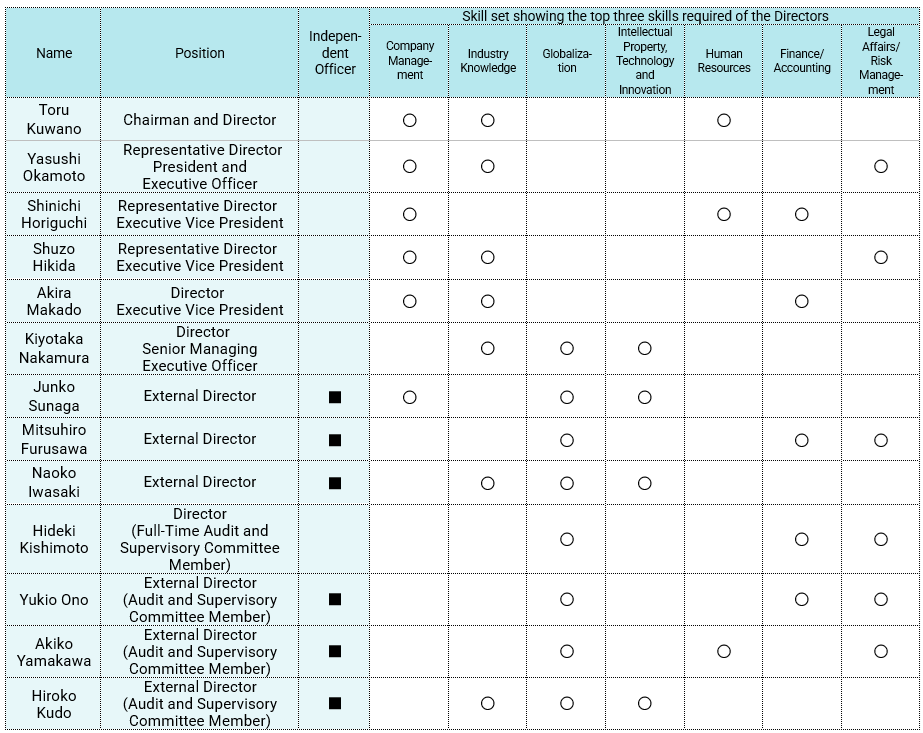
Board of Directors Skills Matrix
The Board of Directors needs to have a wide range of knowledge, experience and diversity in order to ensure the sustainable growth of the Company and increase its corporate value over the medium to long term. The experience, knowledge, skills, etc. that we consider to be particularly necessary have been set out below based on our materiality, GroupVision2032, and Medium-Term Management Plan 2024-2026.
| Skills Item | Skills Explanation |
|---|---|
| Company Management | Experience as a company representative director, or practical experience in evaluating important business opportunities and risks, making risk-taking decisions, and achieving business transformation as a manager with knowledge of corporate governance premised on sustainable management |
| Industry Knowledge | Cutting-edge knowledge of ICT and DX, as well as extensive knowledge and expertise in the information services industry and cybersecurity, all of which are necessary for promoting DX together with customers |
| Globalization | Practical experience in management of a company that operates globally, or practical experience in understanding the opportunities and risks of global business and engaging in business expansion overseas |
| Intellectual Property, Technology and Innovation | Expertise in intellectual property, which is essential for sustained improvement of corporate value, or practical experience and knowledge in driving innovation that brings prosperity to society through applied technology, and other such tools |
| Human Resources | Knowledge and practical experience to secure and promote the active participation of talented human resources capable of providing high added value, and to foster a work environment and corporate culture in which diverse human resources can work with motivation and peace of mind |
| Finance/Accounting | Possess knowledge of corporate finance necessary for medium- to long-term sustainable value creation, and practical experience in decision-making regarding investment and financial strategies |
| Legal Affairs/Risk Management | Expertise and practical experience in legal matters essential for the development of service businesses and global businesses, or knowledge of risk management necessary for a company to survive |
<Skills matrix>
Among the skills possessed by each member, the skills that are particularly expected
Profiles of our corporate officers are available here .
Training Policy for Directors
For directors, including external directors, the Company will provide and arrange training opportunities that are appropriate for individual directors and will cover the cost of such training. The objective of such training is to provide opportunities to acquire knowledge necessary to the Group’s business pursuits, financial affairs and organization and to understand the duties and responsibilities that directors must fulfill in assuming office, as well as to continuously update these skills and knowledge during terms of office.
External Directors
The Company has six external directors. The determination of the independence of external directors is prescribed by the requirements of the Companies Act as well as judgement criteria to ensure the independence of external directors as described below, with reference to the rules and regulations of the Tokyo Stock Exchange.
For reference: Criteria Concerning Independence of External Directors (revised June 23, 2026)
In order to strengthen the supervisory function of the Board of Directors, the determination of the independence of external directors is prescribed by the requirements of the Companies Act as well as judgment criteria to ensure the independence of external directors as described below, with reference to the rules and regulations of the Tokyo Stock Exchange.
- External Directors (including candidates) are defined by Article 2, Paragraph 15 of the Companies Act (Requirements of External Directors) and have never served as an Executive Director, manager or other employee of the TIS INTEC Group (Note 1) even in the past.
- In he three most recent fiscal years, none of each of the following items shall apply to external directors.
- A counterparty which has transactions principally with the Company (Note 2) or a person who executes that counterparty’s business
- A counterparty which has transactions principally with the TIS INTEC Group (Note 3) or a person who executes that counterparty’s business-
- A consultant, accounting professional or legal professional who has received a large amount of money or other assets (Note 4) other than remuneration of officers from the Company. In addition, when these are received by an organization such as a corporation or partnership, this includes persons who belong to the applicable organization.
- A major shareholder of the Company (Note 5). In addition, when the major shareholder is a corporation, this includes a person who executes the business of the corporation.
- A person other than those in (I), (II) and (III) above who executes the business of a counterparty of the Company (Note 6)
- A person who was formerly a member of a counterparty which is in a situation of cross-assumption of offices of external directors
- A counterparty or former member of the counterparty that receives donations from the Company
- External officers must not be a relative within the second degree of a person who falls under each of the following items.
- A person mentioned in (I) to (III) of the previous clause
- A person who executes the business of a subsidiary of the Company
- A non-executive director of a subsidiary of the Company (limited to external auditors)
IV.A person who fell under (II) or (III) above or a person who executes the business of the Company (including a non-executive director in the case of an external auditor) recently (in the current and during the past four business years)
- In addition to the above, there exist no circumstances in which duties imposed on an independent external director are reasonably deemed not to be achieved.
- Note 1 : The “TIS INTEC Group” means the Company and its subsidiaries.
- Note 2 : A “counterparty which has transactions principally with the Company” means a counterparty which provides products or services to the Company and whose payments from the Company constitute at least 2% of the sales of such counterpart in one fiscal year. The main bank (MUFG Bank, Ltd.) and the lead managing underwriters (Nomura Securities Co., Ltd., Mitsubishi UFJ Morgan Stanley Securities Co, Ltd., and SMBC Nikko Securities Inc.) of the Company shall also each be a “counterpart which has transactions principally with the Company,” regardless of the transaction amount.
- Note 3 : A “counterparty which has transactions principally with the TIS INTEC Group” means a counterparty with sales exceeding 2% of the total consolidated sales of the TIS INTEC Group.
- Note 4 : “A large amount of money or other assets” means the total value exceeding 10 million yen per fiscal year.
- Note 5 : A “major shareholder” means a person or company, and the like, that directly or indirectly holds 10% or more of total voting rights. However, the Company’s leading shareholders (the top 10 approximately) shall be treated as “major shareholders.”
- Note 6 : A “counterparty which has transactions with the Company” means the case when transactions with the Company per fiscal year constitute at least 2% of non-consolidated sales of the Company.
Primary Activities of External Directors and External Auditors (Year ended March 31, 2026)
| Status | Name | Primary Activities |
|---|---|---|
| Director | Naoko Mizukoshi | Ms. Mizukoshi attended 15 out of the 16 meetings of the Board of Directors, which were held during the fiscal year under review, and provided advice and recommendations to ensure validity and appropriateness of decision-making of the Board of Directors from her professional viewpoint as a lawyer. Also, she has served as a member of the Nomination Committee and the Remuneration Committee, which are voluntary advisory bodies to the Board of Directors, attending all 11 meetings of the Nomination Committee and all 5 meetings of the Remuneration Committee held during the fiscal year under review, and playing an important role upon reporting to the Board of Directors. |
| Director | Junko Sunaga | Ms. Sunaga attended all 16 meetings of the Board of Directors, which were held during the fiscal year under review, and provided advice and recommendations to ensure validity and appropriateness of decision-making of the Board of Directors based on her abundant experience and insight in corporate management. Also, she has served as chairperson of the Nomination Committee and the Remuneration Committee, which are voluntary advisory bodies to the Board of Directors, since June 24, 2025, to respond to the inquiries of the Board of Directors about nomination and remuneration of Directors, etc., attending all 11 meetings of the Nomination Committee and all 5 meetings of the Remuneration Committee held during the fiscal year under review, and playing an important role upon summarizing opinions and reporting to the Board of Directors in response to the inquiries of the Board of Directors about nomination and remuneration of Directors, etc. |
| Director | Mitsuhiro Furusawa | Mr.Furusawa attended 11 out of the 12 meetings of the Board of Directors, which were held after his appointment on June 24, 2025, and provided advice and recommendations to ensure validity and appropriateness of decision-making of the Board of Directors based on the broad insight into fiscal and monetary policy gained as a government official and a global perspective gained as a senior executive at an international organization. Also, he has served as a member of the Nomination Committee and the Remuneration Committee, which are voluntary advisory bodies to the Board of Directors, attending all 8 meetings of the Nomination Committee and all 3 meetings of the Remuneration Committee held since his appointment on June 24, 2025, and playing an important role upon reporting to the Board of Directors in response to the inquiries of the Board of Directors about nomination and remuneration of Directors, etc. |
| Auditor | Yukio Ono | Mr. Ono attended all 16 meetings of the Board of Directors and all 13 meetings of the Audit & Supervisory Board, each of which were held during the fiscal year under review, and provided recommendations to ensure appropriateness of decision-making of the Board of Directors from his professional viewpoint as a certified public accountant. Also, he made the necessary remarks as appropriate at meetings of the Audit & Supervisory Board. |
| Auditor | Akiko Yamakawa | Ms. Yamakawa attended all 16 meetings of the Board of Directors and all 13 meetings of the Audit & Supervisory Board, each of which were held during the fiscal year under review, and provided recommendations to ensure appropriateness of decision-making of the Board of Directors from her professional viewpoint as a lawyer. Also, in addition to making the necessary remarks as appropriate at meetings of the Audit & Supervisory Board, she has served as a member of the Nomination Committee and the Remuneration Committee, which are voluntary advisory bodies to the Board of Directors, attending 8 out of 11 meetings of the Nomination Committee and all 5 meetings of the Remuneration Committee held while she was in office during the fiscal year under review, and playing an important role upon reporting to the Board of Directors. |
| Auditor | Hiroko Kudo | Ms. Kudo attended 15 out of 16 meetings of the Board of Directors and 12 out of the 13 meetings of the Audit & Supervisory Board, each of which were held during the fiscal year under review, and provided recommendations to ensure appropriateness of decision-making of the Board of Directors with her high level of knowledge and insight as an academic expert. Also, she made the necessary remarks as appropriate at meetings of the Audit & Supervisory Board. |
Note:In addition to the above-mentioned number of meetings of the Board of Directors that were held, we have made four written resolutions deemed to have been made by the Board of Directors based on the provisions of Article 370 of the Companies Act and Article 27 of the Articles of Incorporation.
Summary of Content of Liability Agreements
In accordance with Article 427, Paragraph 1 of the Companies Act, each of the external directors enters into an agreement with the Company that limits legal responsibility for liability compensation as set forth under Article 423, Paragraph 1 of the same law.
The limit of liability compensation, based on these agreements, is an amount provided for in Article 425, Paragraph 1, of the same law.
Overview of the contents of the indemnity agreement, etc.
The Company has concluded an indemnity agreement as stipulated in Article 430-2, Paragraph 1 of the Companies Act with Directors. The Company will provide indemnification for expenses described in Article 430-2, Paragraph 1, item (i) of the Companies Act and losses described in item (ii) of the same, within the scope prescribed in laws and regulations. Certain measures, however, have been taken to ensure that this indemnity agreement does not impair the proper execution of duties of officers of the Company, such as excluding officers from eligibility for indemnification if the relevant duties were performed in bad faith or with gross negligence, and if the Company enforces the liability of officers.
Overview of the contents of the officers’ liability insurance contract
The Company has concluded an officer liability insurance contract as stipulated in Article 430-3, Paragraph 1 of the Companies Act with an insurance company as follows:
1. Scope of the insured
- (1) Directors, audit & supervisory board members and executive officers of the Company and consolidated subsidiaries of the Company
- (2) Executive officers and employees who are dispatched to or concurrently serving at overseas subsidiaries and overseas investment companies of the Company
2. Overview of the contents of the insurance contract
In the event of a claim for damages due to an action (including in-action) by the insured as part of their duties as officers of the company, that falls under (1), damages including compensation for damages and legal expenses to be borne by the insured shall be compensated for under the said insurance agreement. However, damages, etc., incurred by officers themselves who have conducted a criminal act such as bribery and/or intentionally conducted an illegal act are not subject to compensation. This way, measures are taken to ensure that the appropriateness of the execution of duties by officers, etc. is not impaired.
The Company bears the full amount of insurance premiums including the rider portion, and there are no substantial premiums borne by the insured.
Overview of the policies for determination of remuneration, etc.
1. Remuneration determination policies
In order to ensure objectivity and transparency of the remuneration determination process and further strengthen the corporate governance framework, the Company has set up an arbitrary remuneration committee consisting mainly of Independent External Directors as an advisory body to the Board of Directors.
Officers' remuneration is determined by the resolution of the Board of Directors after consulting and reporting to the Remuneration Committee with the basic policy of strengthening incentives to improve performance by implementing a remuneration system linked to the company performance indicators.
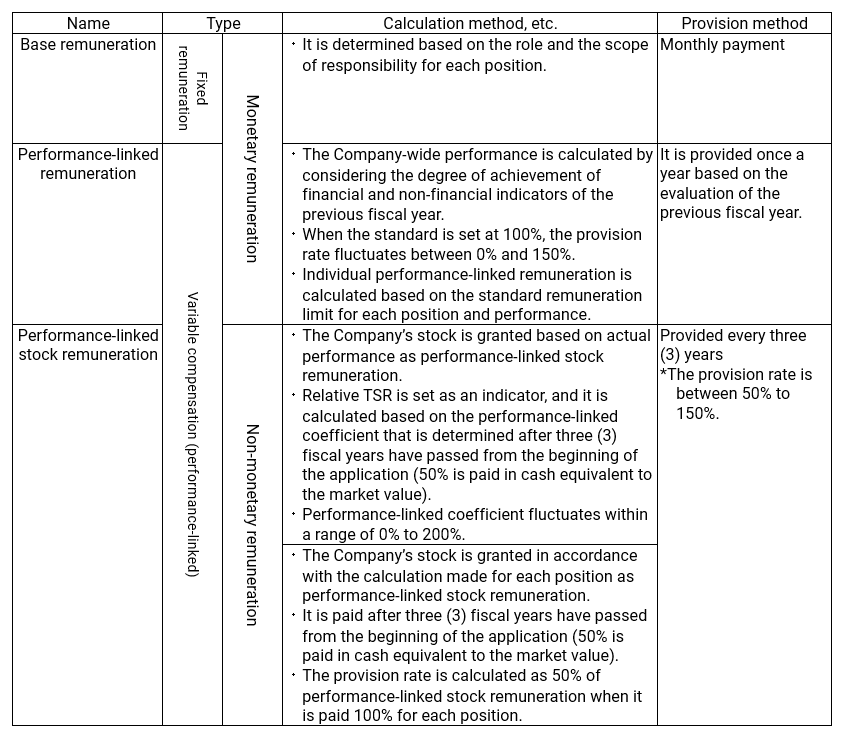
2. Remuneration structure for officers
The Company's remuneration system consists of base remuneration, performance-linked remuneration and performance-linked stock remuneration. Each remuneration's type, calculation method and provision method are as follows.
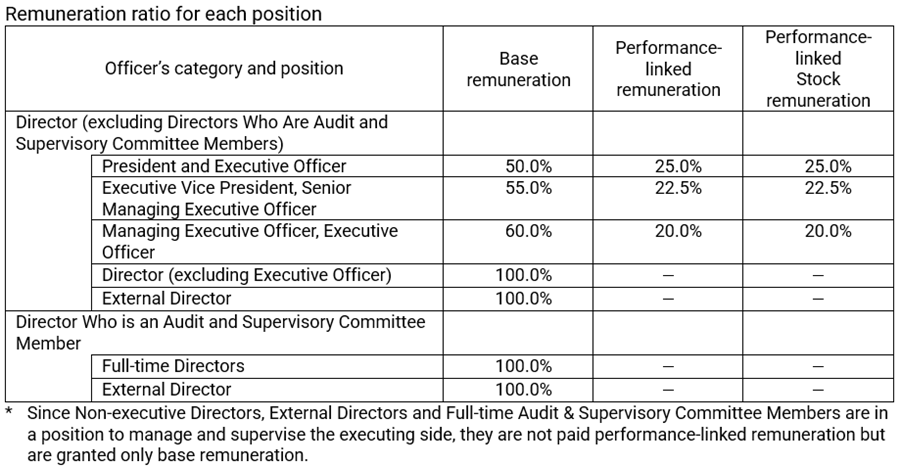
3. Remuneration structure for External Directors (excluding Audit and Supervisory Committee Members) and Audit and Supervisory Committee Members
Remuneration paid to external directors (excluding Audit and Supervisory Committee Members) consists solely of basic remuneration, and no performance-linked remuneration will be paid. Also, remuneration for the directors who are Audit and Supervisory Committee Members (hereafter, Audit and Supervisory Committee Members) will be determined in consultation with the Audit and Supervisory Committee and, from the perspective of ensuring a high degree of independence, will not be linked to performance and consist solely of basic remuneration.
4. Other
When the performance-linked stock remuneration system was introduced, the Board of Directors resolved to stipulate activities that are not complying with the stock delivery regulations for the Executive Compensation BIP Trust (the “stock delivery regulations”) and a clause that makes it possible to request that a person who has violated the regulations returns the amount equivalent to the delivered shares, etc. and a clause that makes it possible to confiscate the awarded points.
5. Process to determine officers’ remuneration
- (1) Based on the medium-term management plan, evaluate the results including the status of achievement of the business plans drawn up at the beginning of the fiscal year at a performance evaluation meeting to be held in late May, every year.
- (2) At the performance evaluation meeting mentioned in (1) above, the Representative Director, President and Executive Officer evaluates officers.
- (3) Consult on the evaluation result of (2) above and the amount of remuneration based on the evaluation result at the Remuneration Committee to be held in mid-June each year.
- (4) The Board of Directors shall resolve the amount of remuneration for officers, which has been mentioned to and discussed with the Remuneration Committee mentioned in (3) above.
- (5) Among the annual amount of officers' remuneration, which has been resolved at the meeting of the Board of Directors as described in (4) above, base remuneration is paid monthly while performance-linked remuneration is paid in one lump sum in July.
- (6) As for the level of the amount of officers' remuneration, we ask a third-party organization to conduct a survey on officers' remuneration to analyze trends of other companies from July each year.
- (7) We report the result of the officers' remuneration survey conducted by the third-party in (6) above to the Remuneration Committee in February each year to inquire about a revision of the amount of officers' remuneration.
Performance-linked stock remuneration is calculated based on the stock delivery regulations, and there is no room for discretion of the Representative Director or the Remuneration Committee.
6. Activities of the Advisory Committee with respect to determination of officers’ remuneration
A total of five Remuneration Committee meetings were held in the fiscal year ended March 31, 2026, to inquire about the validity of the remuneration of the Company based on comparative analysis between the officers' remuneration amount of the Company and the officers' remuneration of other companies, which had been made by the research company. The Board of Directors put a proposal on officers' remuneration on the agenda based on the result of the advice given by the relevant organization.
7. Method of calculating remuneration
The calculation methods for the base remuneration, performance-linked remuneration and performance-linked stock remuneration shown in 2. are as follows:
(1) Base remuneration
Paid based on the magnitude of the role and the scope of responsibility for each position.
(2) Performance-linked remuneration
For the calculation of performance-linked remuneration, a provision rate is calculated based on company-wide performance, the performance of the responsible organization and individual appraisal. Then, a performance evaluation ratio for each position is added to the calculated provision rate. The delivered rate is used for the calculating individual payments (0% to 150%). The specific calculation method is as follows:
Performance-linked remuneration assessment item
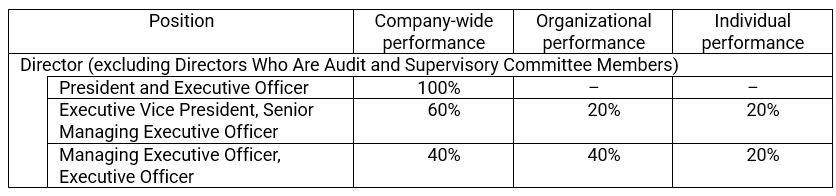
(i) Allocation ratio of performance evaluation for each position
The amount of individual performance-linked remuneration is calculated by determining an allocation ratio of performance evaluation for each position as follows, and calculating an evaluation score for company-wide performance, the performance of the responsible organization and individual appraisal separately.
(ii) Determination of company-wide performance evaluation score
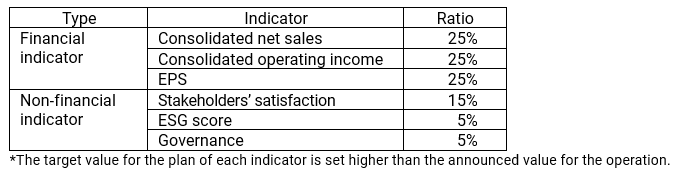
1) Company-wide performance indicator and evaluation ratio
Company-wide performance evaluation is determined with the degree of achievement of the plan for each indicator and each indicator's ratio.
A company-wide performance score is calculated based on the company-wide performance score formula in 2).
2) Company-wide performance evaluation score formula
A company-wide performance evaluation score is determined using the formula below based on the degree of achievement of the target value for each company-wide performance indicator and each indicator's ratio.
Company-wide performance evaluation score = Σ (Degree of achievement of each financial indicator × each ratio) + Σ (Degree of achievement of each non-financial indicator × each ratio)
*The upper limit is 150% if it exceeds 150%.
(iii) Determination of organizational performance evaluation score
Organizational performance is calculated within a range of 0 to 100 points based on the degree of achievement of financial and non-financial indicators for the officer's responsible organization during the target fiscal year for the performance evaluation. The calculated organizational performance evaluation score is divided by the base score of 66.5 points so that it falls within a range of 0% to 150%, and the evaluation score is determined within a range of 0% to 150%.
Organizational performance evaluation score = Performance evaluation of responsible organization/base score
*The upper limit is 150% if it exceeds 150%.
(iv) Determination of individual performance evaluation score
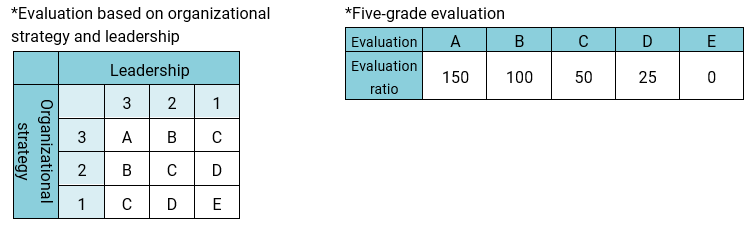
An individual performance evaluation score is delivered as a final five-grade evaluation based on the two-axis evaluation assessing the progress of the strategies developed as targets by an eligible officer for his/her responsible organization in the previous fiscal year (three-grade evaluation) and the degree of leadership demonstrated (three-grade evaluation) by the officer.
(v) Formula for individual performance-linked remuneration
(i) Allocation ratio of performance evaluation for each position, (ii) Company-wide performance, (iii) Organizational performance and (iv) Individual performance described above are separately evaluated. The amount of remuneration is determined with the following formula.

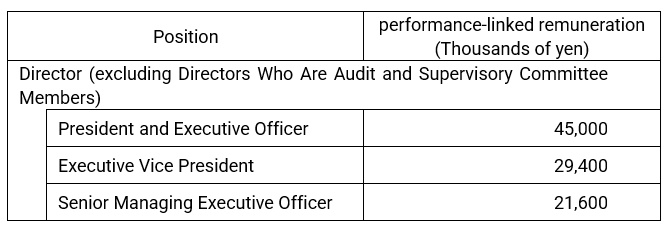
(ⅵ) Upper limit of performance-linked remuneration
(3) Performance-linked stock remuneration
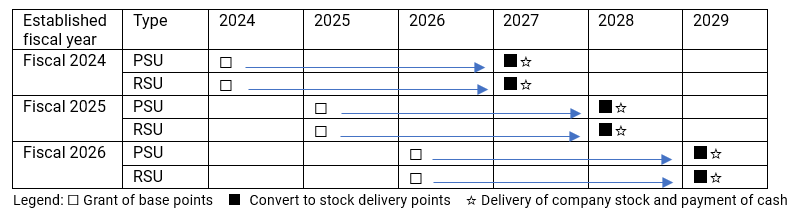
Performance-linked stock remuneration is a system that provides non-monetary remuneration (hereinafter referred to as the "System"). The Company establishes an incentive plan that covers consecutive three (3) fiscal years (hereinafter referred to as the "Assessment Period") as the consideration for executing duties during the target job execution period. Under the System set in fiscal 2024, the Company grants officers who are eligible for the System (hereinafter referred to as "Eligible Officers") 50% each of the base points defined for each position as a performance-linked part (PSU) and fixed part (RSU) during the Assessment Period of the three (3) consecutive fiscal years from fiscal 2024 to fiscal 2026. As a general rule, in July, after the completion of the Assessment Period, for people who satisfy certain requirements, the number of base points is converted into stock delivery points based on the formula for performance-linked stock remuneration for each person, and the Company's common stock is provided in accordance with the total number of the stock delivery points.
(1 point = 1 share)
About 50% of the Company stock is sold on the stock market to secure the funds to pay taxes and the proceeds of the sales is paid.
- PSU (Performance Share Unit) is the Company's common stock provided after three (3) fiscal years have passed from the beginning of the application to Eligible Officers who belong to the Company as of April 1 of the initial fiscal year of the application based on the growth rate of the Company's stock price during the Assessment Period. (50% is paid in cash equivalent to the market price.)
- RSU (Restricted Share Unit) system is introduced in fiscal 2024 and allows the Company to grant Eligible Officers who belong to the Company as of April 1 of the initial fiscal year of the application a fixed number of the Company's common stock after three (3) fiscal years have passed from the beginning of the application. (50% is paid in cash equivalent to the market price.)
(i) Performance evaluation period (model period from 2024 to 2026)
(ii) Calculation of base amount for each position
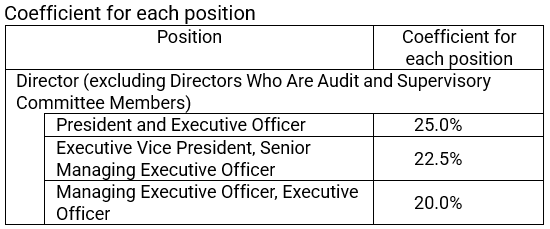
Base amount used to grant points is set for each position as follows:
Base amount for each position = Base remuneration for each position × Coefficient for each position
(iii) Method of calculating point (1 point = 1 share)
1) PSU:
- At the beginning of fiscal year
Number of base points (PSU) =
Base amount for each position × 50% / The Company's stock price at the time of acquisition (figures below the decimal point are omitted) - At the time of performance evaluation (at the time of granting stock)
Number of stock delivery points (PSU) =
Number of base points (PSU) = Number of months of service / 12 months × Performance-linked coefficient (figures below 1 point are omitted) - Performance-linked coefficient
The performance-linked coefficient applied at the time of the performance evaluation (at the time of granting stock) is determined based on relative TSR as follows:

2) RSU:
- At the beginning of fiscal year
Number of base points (RSU)
= Base amount for each position × 50% / The Company's stock price at the time of acquisition (figures below the decimal point are omitted) - At the time of share delivery
Number of stock delivery points (RSU)
= Number of base points (RSU) = Number of months of service/12 months × Performance-linked coefficient (figures below 1 point are omitted)
3) Number of stock delivery points:
Number of stock delivery points = Number of stock delivery points (PSU) + Number of stock delivery points (RSU)
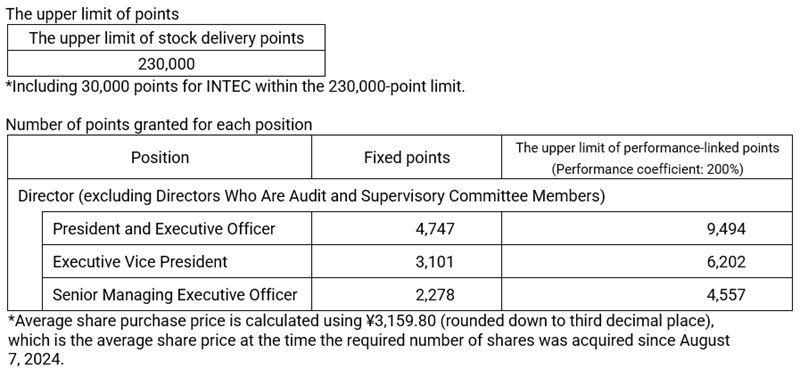
The upper limit on the number of base points granted to executive directors and executive officers (excluding external directors and domestic residents) who fall under the evaluation period from fiscal 2025, ended March 31, 2025, through fiscal 2027 , and the upper limit on the number of stock delivery points associated with conversion of granted base points, are presented below.
One base point is equivalent to one share. However, in the event of a share split, reverse split, also known as share consolidation, or other corporate action related to company shares during the trust period, the number of company shares per point (including the number of shares to be converted) will be adjusted according to the stock split ratio, reverse split ratio or other metric.
In addition, application of fixed point and performance-linked point limits, as presented under Number of Points Granted According to Position, will be based on position titles held upon conclusion of the Ordinary General Meeting of Shareholders on June 23, 2026.
(iv) Calculation method of relative TSR (%) (As an example for the explanation, the case of fiscal 2024 is shown.)
Relative TSR (%) = The Company’s TSR (%) / TOPIX growth rate (%)
The Company’s TSR (%) = (B + C) / A
A: Average closing price of the Company's stock on the Tokyo Stock Exchange in May 2024
B: Average closing price of the Company's stock on the Tokyo Stock Exchange in May 2027
C: Total amount of dividend per share of the Company's stock from the beginning of fiscal 2024 to the end of fiscal 2026
TOPIX growth rate (%) = E / D
D: Average closing price of TOPIX on the Tokyo Stock Exchange in May 2024
E: Average closing price of TOPIX on the Tokyo Stock Exchange in May 2027
Remuneration for Directors and Audit & Supervisory Board Members (Year ended March 31, 2026)
|
|
Recipients (Persons) |
Remuneration (Millions of yen) |
Remuneration by type | ||
|---|---|---|---|---|---|
| Basic remuneration | Performance-linked remuneration | Performance-linked Stock compensation |
|||
| Directors (External Directors) |
12 (4) |
389 (32) |
248 (32) |
65 (-) |
75 (-) |
| Audit & Supervisory Board Members (External Auditors) |
5 (3) |
55 (28) |
55 (28) |
- (-) |
- (-) |
| Total (External Directors and External Auditors) |
17 (7) |
444 (61) |
303 (61) |
65 (-) |
75 (-) |
Notes
- There is no employee portion of salaries for Directors who concurrently serve as employees for the fiscal year under review. Also, no bonuses were paid because the Company has not implemented an Officer retirement benefit system.
- As of the end of the fiscal year under review, there are nine (9) Directors (including three (3) External Directors) and five (5) Audit & Supervisory Board Members (including three (3) External Audit & Supervisory Board Members). It is different from the above-mentioned number of Directors because it includes three (3) Directors (including one (1) External Director) who retired at the conclusion of the 17th Annual General Meeting of Shareholders, which was held on June 24, 2025.
- It has been resolved at the 16th Annual General Meeting of Shareholders, which was held on June 25, 2024, that the amount of remuneration for Directors and Audit & Supervisory Board Members (base remuneration and performance-linked remuneration) shall be 800 million yen or less per year (of which, 100 million yen or less for External Directors) and 150 million yen or less per year for Audit & Supervisory Board Members. At the conclusion of the relevant General Meeting of Shareholders, there are nine (9) Directors (including three (3) External Directors) and five (5) Audit & Supervisory Board Members (including three (3) External Audit & Supervisory Board Members).
- As for performance-linked remuneration, a revised officers' remuneration system was introduced in July 2024 and the amount paid includes performance-linked remuneration based on the previous officers' remuneration system.
- Performance-linked stock remuneration is the amount of expenses recorded during the fiscal year under review for four (4) Directors (excluding External Directors, part-time Directors, and non-residents of Japan).
The relevant performance-linked stock remuneration was introduced with Directors (four (4) persons excluding External Directors and part-time Directors), Executive Officers, and Executive Fellows as eligible persons at the 10th Annual General Meeting of Shareholders held on June 26, 2018. At the 13th Annual General Meeting of Shareholders held on June 24, 2021, partial revisions were made such as adding Directors (excluding External Directors and part-time Directors) and Executive Officers of INTEC Inc., a subsidiary of the Company, as eligible persons. In addition, it was resolved at the 16th Annual General Meeting of Shareholders, which was held on June 25, 2024, to make partial revisions such as limiting the eligible persons to Directors and Executive Officers (excluding non-executive Directors and those who do not reside in Japan), and Directors and Executive Officers (excluding non-executive Directors and those who do not reside in Japan) of INTEC Inc., a subsidiary of the Company, as well as that the number of shares of the Company to be delivered through the trust shall be limited to 230,000 shares per fiscal year (including 200,000 shares for the Company) by contributing a maximum of 1,810 million yen (including 1,630 million yen for the Company) to the relevant trust for each target period (three fiscal years), with the number of Directors (executive Directors) at the time of resolution of said General Meeting of Shareholders standing at three (3).
Constructive Dialogue with Shareholders
TISI will actively engage in constructive dialogue with shareholders based on the IR Policy in order to contribute to the Company's sustainable growth and the enhancement of its medium- to long-term corporate value. In addition, the Company will strive to develop a system to promote constructive dialogue with shareholders.
In the case of dialogue with shareholders, TISI will pay sufficient attention to the fairness of information disclosure and manage internal information appropriately in accordance with the Rules for Prevention of Insider Trading
Status of Dialogue with Shareholders
Led by the President, in fiscal 2026 we engaged in constructive dialogue with shareholders involved in investment management in Japan and overseas, primarily in the United States, and Europe. These investors have diverse approaches, typically focusing on growth and value trading. Most shareholder interactions were with analysts and fund managers, though we also met with individuals responsible for exercising voting rights.
Key topics and areas of shareholder interest (outlined below) were shared and discussed internally through quarterly reports to the Board of Directors and other meetings. This feedback was incorporated into the review of management strategies, the development of management plans, and other corporate initiatives.
Main dialogue themes and matters of interest to shareholders
- Management's view of the current share price level and future actions
- Direction of growth strategies in light of advances in AI and other technologies
- The importance of investing in human resources, our most critical management capital, and corresponding policies
- Approach to allocating cash to increase corporate value (investments in growth and shareholder return)
- Financial strategy and KPIs with an awareness of capital efficiency, and other themes
| IR Events in Fiscal 2026 | Frequency | Notes |
|---|---|---|
| Results briefings for analysts and institutional investors | 4 times |
|
| Small meetings for analysts and institutional investors | 280 times | Including 116 meetings that overseas investors participated in; a total of 560 investors participated in the meetings. |
| Small meetings | 7 times | Four with sell-side analysts, and three with buy-side analysts |
| Overseas roadshows | 2 times | North America, Europe |
| Conference | 5 times | Five conferences in Japan |
| IR conferences for individual investors | 2 times |
|
* Conducted in person or online, taking each situation and other factors into account.
Cross-shareholdings
1. Policies for cross-holdings of shares
In accordance with the basic corporate governance policies set by the Company, the Company will not newly acquire any domestic listed shares, and works to reduce domestic listed shares that it holds as much as possible by positioning it as a priority issue. On the other hand, only if it is judged that it will contribute to the sustainable growth of the Group as well as the enhancement of its medium- to long-term corporate value, shares of companies including start-up and venture companies may be strategically held. Specifically, in order to proactively promote business deployment focusing on the social issues to be resolved, which the Company has selected to contribute to the realization of a sustainable society, including “financial inclusion,” “concentration in cities/decline in rural areas,” “low-carbon/decarbonization” and “health issues,” collaboration and co-creation activity with those companies and stable alliance and cooperative relationships may be essential for continuous creation of business opportunities and utilization of technologies. We position shareholdings for that case as an investment that meets the growth strategy of the Group, and define them as “strategically held shares.”
Upon verifying the rationality of continuing to hold shares, we classify shares held into the following two categories and set a verification method for each of them.
Capital alliance partners
After making an investment, the Company will continue to hold the shares for a certain period of time determined by the Company as a period to establish the foundation of the strategic alliance.
After a certain period of time has passed, we will verify to check the progress status of the collaborative business and to see whether or not there are ongoing transactions through qualitative evaluation. As a result of the verification, if it is judged that there is little significance in holding them, listed shares will be sold based on the market conditions, etc. and unlisted shares will be sold as soon as a buyer is found in consultation with the issuer.
Others (items not covered by the above)
We will calculate the percentage of the total amount of the business-related revenue and dividends from each issuer and its affiliated companies against the amount of shares of each stock held as cross-shareholdings, which is recorded on the balance sheet to check to see whether or not it exceeds 10%. As a result of the verification, also considering the qualitative evaluation such as future transaction prospects, if it is judged that there is little significance in holding them, listed shares will be sold based on the market conditions, etc. and unlisted shares will be sold as soon as a buyer is found in consultation with the issuer.
Also, while proceeding with reduction in line with the above-mentioned policies and concepts, we aim to lower the percentage of the amount of the cross-shareholding shares recorded on the balance sheet against the consolidated net assets to the 10% level. To achieve this goal, we reduced 8 issues of shares held for cross-holdings, including 6 issues sold in full. Due to fluctuations in the market value in the stock market in addition to the above-mentioned reduction, the amount recorded on the balance sheet for the fiscal year ended March 31, 2026 decreased by 2.9 billion yen to 20.2 billion yen. As a result, the above-mentioned percentage in the fiscal year ended March 31, 2026 is 6.0% (down 0.5 percentage points year on year), and the percentage excluding strategically held shares is 1.5%.
2. Criteria for exercising voting rights for cross-shareholdings
We will exercise voting rights for listed shares held properly after comprehensively judging whether or not it will contribute to the sustainable growth of the Group and the investees as well as the enhancement of their medium- to long-term corporate value among others also while considering the proxy advisory policies of proxy advisory firms.
3. Number of issues held by the Company for purposes other than portfolio investment and total amounts recorded on the balance sheet
| Category | Fiscal 2025, ended March 31, 2025 | Fiscal 2026, ended March 31, 2026 | ||
|---|---|---|---|---|
| Number of issues | total | 79 issues | 82 issues | |
| (of which) | Strategic shareholdings | 61 issues | 64 issues | |
| Cross-shareholdings | 18 issues | 18 issues | ||
| Total balance-sheet amount | total | 23,140 million yen | 20,212 million yen | |
| (of which) | Strategic shareholdings | 14,998 million yen | 14,981 million yen | |
| Cross-shareholdings | 8,141 million yen | 5,231 million yen | ||
Note: During the fiscal year under review, for the purpose of strategic collaboration to promote open innovation, etc., we newly acquired shares of 9 capital alliance partner companies, including a venture company (941 million yen).
4. Relationships with strategic shareholders
If strategic shareholders of TISI indicate an intention regarding the sale, etc. of TISI shares, we will respond appropriately without preventing such a sale. Moreover, we will not conduct transactions that lack economic rationality with strategic shareholders.
Takeover Defense Measures
TISI will not introduce takeover defense measures based on the belief that continuously enhancing corporate value through sound and rational management is in and of itself the most effective defense against hostile takeover bids.
Messages from external directors/Dialogue opportunities
We share messages from external directors and the content of dialogue opportunities with external directors about management practices to improve the Group's corporate value over the medium to long term.
For more information, click here.