
Message from the Director in Charge of Finance
Financial Policy: Basic capital policies
Realize sustainable improvement in corporate value through the creation of an optimal capital structure that balances efforts to leverage growth investments, ensure financial health and enrich shareholder returns from a medium- to long-term management perspective
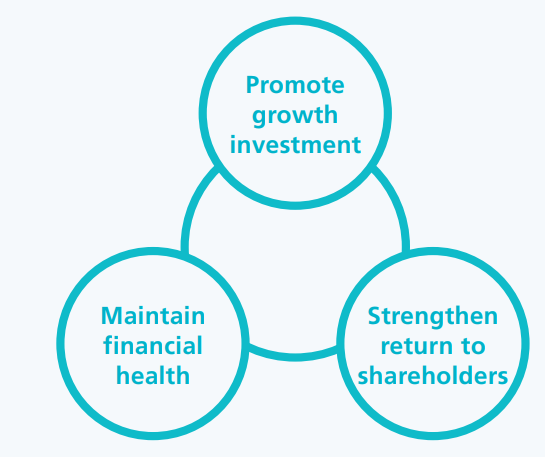
- Take robust approach to growth investments and, as part of this process, constantly review and restructure business portfolio to reinforce ability to generate cash through sustainable increase in business profits and improved profitability.
- Through stronger balance sheet management, build optimal capital structure aligned to progress in structural transformation to maintain financial health and constantly deliver returns that exceed cost of capital.
- Strive to enrich shareholder returns commensurate with business growth.
Q1.You’ve completed the second year of the medium-term management plan. When the plan was first announced, management came under criticism for setting the bar too high—that stated goals were not realistic. Where does progress stand now?
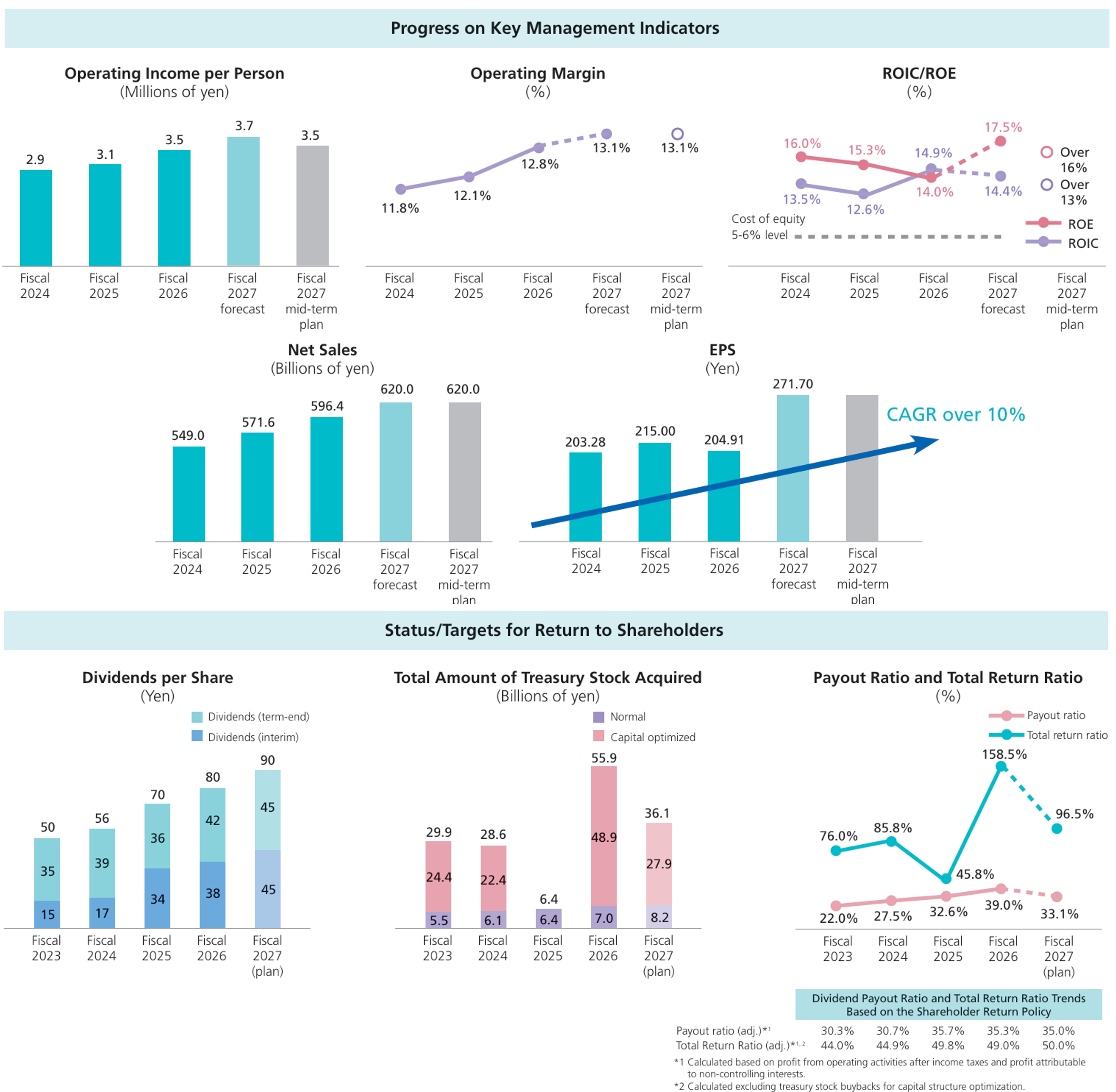
When the medium-term management plan was first announced, we, too, recognized the challenging journey that lay ahead and that, from a market perspective, we had set the bar quite high. We knew that reaching our performance targets would require a significant leap as we approached the final year rather than simple linear increases over the three years of the plan. Against this backdrop, as we marked steady business growth in the first and second years of the medium-term management plan, the market’s harsh view of our prospects gradually softened. Market consensus improved and became more positive. I’ll go into detail later, but let me say here that we are actively promoting financial measures, and we believe we are making steady progress, having reached a stage where we can demonstrate our commitment to achieving stated targets by setting key performance indicators, such as ROE and EPS, for fiscal 2027 as guideposts on our journey.
However, profit attributable to owners of parent for fiscal 2026 fell short of our target and came in below the previous fiscal year as well, owing to impairment losses and provisions related to pending litigation. This is a key management issue and one we take very seriously. Nevertheless, in regard to return to shareholders, we increased dividends in line with business growth, in accordance with our shareholder return policy, which calculates the total payout ratio based on profits from operating activities after deducting income taxes and non-controlling interests. As a result, dividends charted upward for the 14th straight year and exceeded initial expectations. So, while challenges remain, we see fiscal 2026 as a year of steady progress through continued business growth.
Q2. Concerns about AI disruption have created a more pessimistic outlook for the IT services industry as a whole. The medium-term management plan may be unfolding nicely, but what do you make of this market environment?
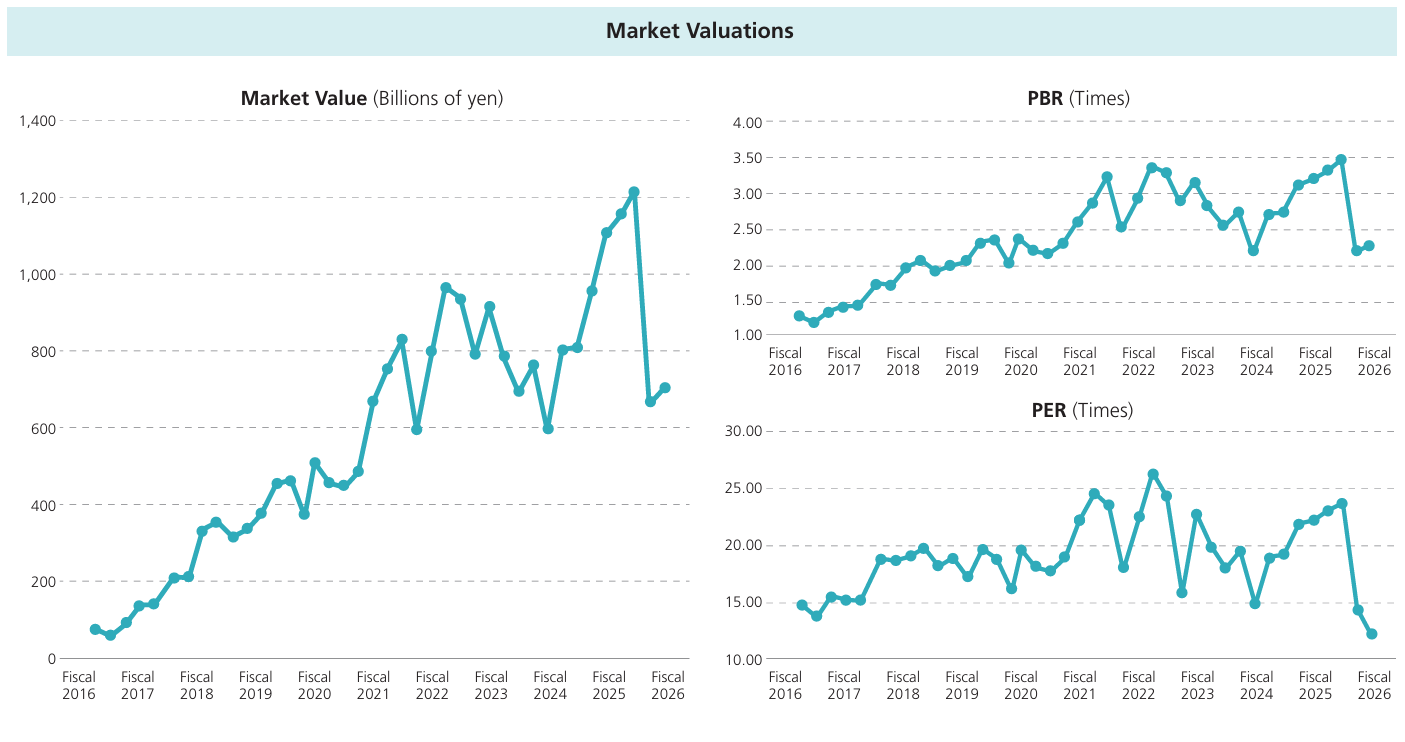
Execution of the medium-term management plan is progressing smoothly, and we have reinforced the foundation of corporate value in terms of enhanced profitability and capital efficiency. However, perceptions regarding the business model used by system integrators have shifted since early in 2026 against the backdrop of advances in AI. There is a growing sense of uncertainty that the value provided by system integrators will be replaced over the medium to long term, and that business performance will be eroded in the short term. I believe market sentiment toward the entire industry—and we are no exception—took on a more cautious tone. As a result, a gap appeared between corporate value and market expectations—a situation I feel stems not so much from an assessment of our current business performance but rather from different perspectives on our medium- to long-term growth potential. In other words, a discrepancy currently exists between intrinsic corporate value, reflecting the medium- to long-term growth we have assumed to date, and growth potential perceived by the market. From our perspective, a key reason for this is that the market has yet to properly evaluate the kind of value we can continue to deliver going forward or our ability to maintain and accelerate growth given advances in AI.
During fiscal 2026, our emphasis was on communicating initiatives for medium- to long-term growth and engaging in dialogue to ensure that our strategies were understood. In July 2025, the decision to merge TIS and INTEC was made and announced, and in October 2025, a concrete vision for the core company—TISI—was defined, with a goal to generate more than ¥60 billion in sales through merger synergies. Then in March 2026, management decided to implement a flexible share buyback scheme, underlining its commitment to improving corporate value from a financial strategy perspective. A dual approach using both business and financial strategies is needed to increase corporate value. In addition to communicating our growth strategy, we began putting into place integrated financial measures conscious of capital efficiency. Then, in May 2026, perceiving changes in industry structure driven by AI as a huge opportunity for growth, we announced growth expectations for the Group—consolidated net sales at the ¥1 trillion mark and operating income exceeding ¥150 billion by fiscal 2033. Ahead of the announcement of the next medium-term management plan, scheduled for May 2027, management has already revealed the strategic direction under the new plan. This not only outlines a path toward achieving the goals of our current medium-term management plan but also signals that we have entered a phase for dialogue with capital markets on the direction of future growth.
Q3.Despite commendable efforts to implement growth strategies and financial measures, a gap appears to remain between these efforts and the market’s assessment of corporate value. This begs the question—again—have efforts to date been somehow lacking?
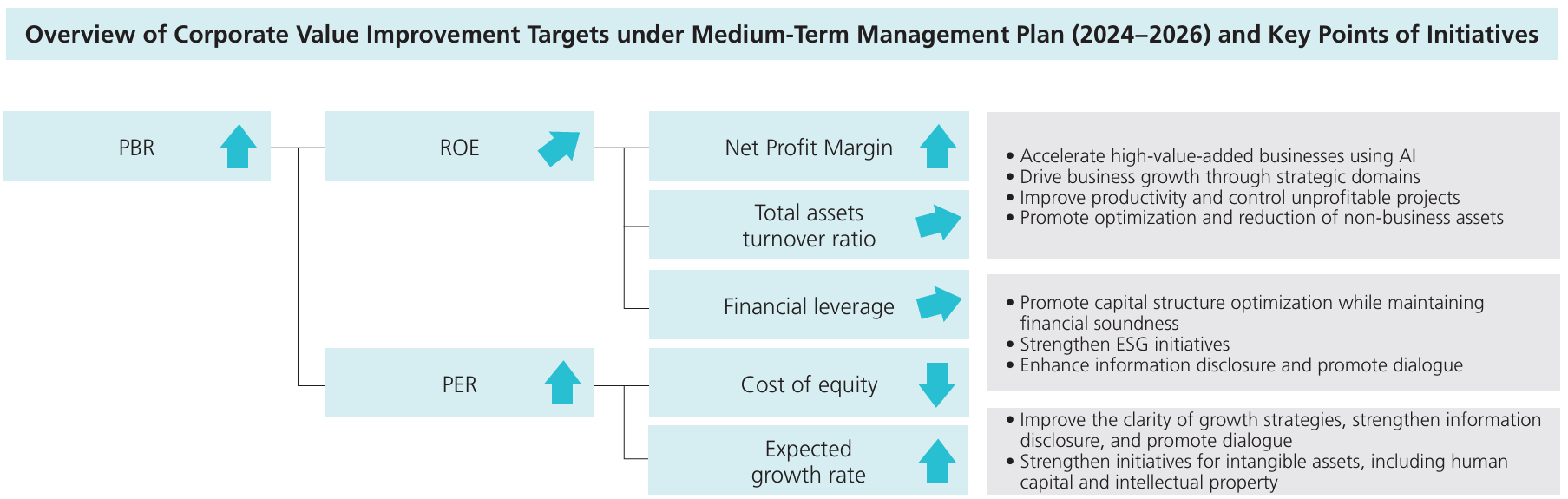
We place a high priority on enhancing corporate value based on PBR. We analyze capital efficiency in terms of ROE and PER, and further break down PER into its components—cost of capital and growth expectations. We seek to maintain and improve capital efficiency through business growth and financial measures, and we believe we have laid a solid foundation in this regard. At the same time, we acknowledge that our current challenge lies mainly in PER—specifically, the ability to cultivate growth expectations.
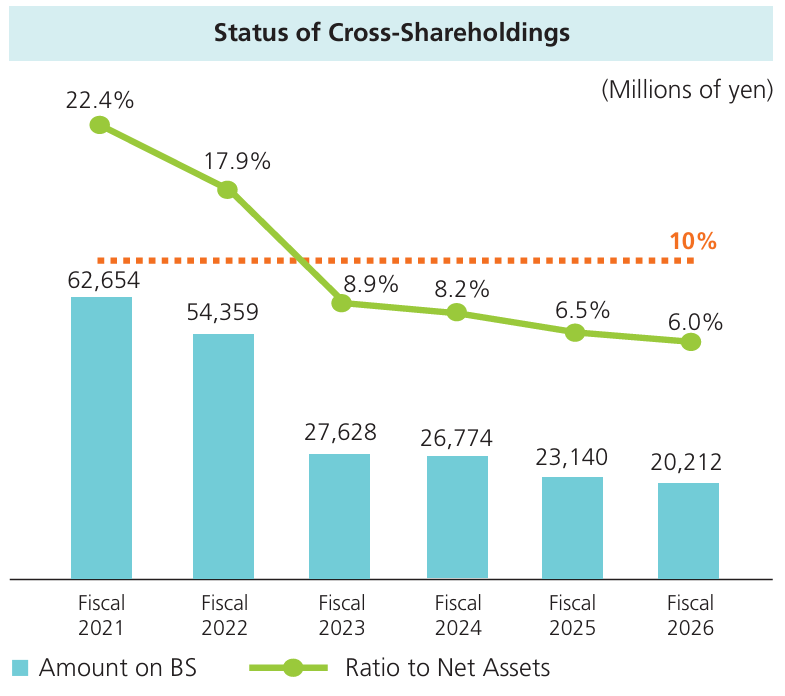
To reduce cost of capital—the other component of PER—from a balance sheet management perspective, we have promoted repurchase of treasury stock while streamlining strategic shareholdings and closely monitoring our cash position. This approach has prevented an excessive rise in the equity ratio and helped us optimize our capital structure while ensuring financial health. The balance sheet carrying amount of strategic shareholdings amounted to ¥20.2 billion as of the fiscal 2026 year-end, on March 31, 2026, representing 6.0% of consolidated net assets, and thus below the 10% target level.
Meanwhile, our expected growth rate isn’t rising, and our PER remains an issue in need of a solution. There’s a gap between the market’s expectations and our own assessment of growth. Bluntly speaking, I think our stock is trading at a significant discount. What caused this? First—concerns about AI disruption across the whole IT services industry, as I mentioned earlier. Second—an insufficient effort on our part to establish a clear view of TISI as a company—and the TIS INTEC Group as a corporate group—that integrates AI into its growth strategy to enhance the value provided to clients. One contributing factor is a lack of quantitative information, such as the extent to which AI has been adopted into which areas and the KPIs used to measure progress and impact. Also, the Group portfolio includes outsourcing and on-site operations at client premises—business pursuits we consider essential—and a certain perception runs in the market that these pursuits could be negatively impacted by AI. The fact that we haven’t properly articulated how these businesses will evolve and what role they will play as adoption of AI becomes more widespread is, given the diversity of the Group portfolio, what I believe is the root cause of the discount situation. In talking with market participants, I sense they don’t know us very well at all. We need to go beyond simply highlighting our strengths to ensure the market truly understands our business structure, market positioning and the value we provide. Compounding these factors is a skewed view of earning power. This is because, even though business results have charted upward and on track to targets stated in the medium-term management plan, sales growth and improvement in the gross profit margin have been modest in recent years. However, as I already mentioned, we remain tireless in our efforts to achieve medium- to long-term growth, and in regard to profitability, we are firmly committed to a management approach that prioritizes future-oriented investments, including investment in human resources, rather than chasing short-term profits. In particular, we consider efforts to enrich human capital—the source of competitive advantage in the age of AI—to be a strategic investment. We seek to create value that hinges on human involvement, underpinned by the ability to envision business transformation and integrate technical expertise with operational insights to deliver results. We believe these efforts will bring sustainable depth to human capital and enhance corporate value.
The market’s lack of understanding about our business model, business structure and value proposition, as well as low expectations regarding our ability to generate profits, are significant discount-fueling factors stemming from internal issues that we ourselves must address. We aim to resolve these issues as soon as possible by sharpening the strategic clarity of measures to achieve top-line growth driven by merger synergies and our long-term vision for the Group. We will demonstrate this ability through actual results, engage often with market participants, and strive to further refine this approach.
Q4.In fiscal 2026, even with a proactive capital policy in place, then-TIS initiated the largest repurchase of treasury shares in the Company’s history. Can you provide some background to the decision and the purpose of the share buyback?
We are deeply committed to enhancing value for our shareholders and have consistently utilized share buybacks as a means to achieve this. This approach also aligns with balance sheet management objectives, such as optimizing capital structure and improving capital efficiency.
In fiscal 2026, we executed our largest repurchase of treasury stock ever under a flexible capital policy designed for agility amid changes in the business environment to improve shareholder returns and capital efficiency. First, in May 2025, management resolved to repurchase treasury stock equivalent to a total of ¥42 billion—¥7 billion to maximize shareholder value and ¥35 billion to optimize our capital structure. In line with this decision, we completed the repurchase of approximately ¥42 billion worth of shares between May 2025 and December of that year. Of this amount, the ¥35 billion portion tapped to optimize our capital structure was cancelled in February 2026, in accordance with our shareholding policy and to allay concerns regarding future dilution. Then, in March 2026, management approved an additional measure to repurchase treasury stock worth ¥50 billion in total. This measure includes planned repurchases based on our shareholder return policy of a 50% total return ratio and exemplifies agile decision-making free from the constraint of traditional timing to financial results announcements. Our growth strategy—which takes widespread adoption of AI into account—could lead to enhanced corporate value over the medium to long term. Based on this assumption, I believe the market has yet to fully reflect our intrinsic corporate value into current stock price as we see it. Management felt additional measures were needed sooner than later and that they would inevitably reinforce our ability to achieve the targets set in our medium-term management plan, notably, ROE above 16% and an EPS growth rate exceeding 10%.
Behind our agile decision-making is the direct, head-on approach we’ve taken to enhance corporate value with a focus on stock price. It reflects the fact that we don’t view market feedback as a mere external evaluation but rather as a guide for improvement. The sharp decline in our stock price since early 2026 caused shareholders and investors considerable concern and has, in fact, elicited some harsh criticism. Our market capitalization, which topped ¥1.2 trillion at the end of 2025, fell below ¥700 billion at times, so concerns from a stakeholder perspective are entirely justifiable. I myself felt a strong sense of crisis and frustration, and to fulfill my responsibility as a bridge to the market, I shared feedback with the Board of Directors and made stakeholder concerns a discussion priority. External directors have also engaged in direct dialogue with shareholders and investors and thus have a two-front understanding of market expectations and issues requiring the Company’s attention, which sets the stage for in-depth discussions by the Board of Directors. This has resulted in faster, smoother decision-making on measures to help improve corporate value.
We see these share buybacks not merely as a form of returning value to shareholders but as a process that pushes corporate value higher. Going forward, we will continue to take a flexible approach to the implementation of capital policy that improves capital efficiency and enhances value for shareholders with due consideration to balance sheet management and dialogue with market participants.
Q5.TISI maintains a robust capital policy, epitomized by the recent share buybacks. But what about overall cash allocation, particularly in terms of balancing that with growth investments? And how do you explain M&A and investment activity that deviates from stated plans?
Our basic approach to cash allocation is to direct funds in a timely and appropriate manner into investments that will drive corporate value higher. In making any decision, we carefully consider the balance between promoting growth investments, ensuring financial soundness, and strengthening shareholder returns to achieve sustainable improvement in corporate value, in accordance with basic financial and capital policy.
The IT services industry, to which TISI belongs, is poised to capitalize on strong demand for IT investment. But the competitive landscape will likely undergo rapid transformation in the near term against the backdrop of advances in AI. In this environment, we know that enhancing the value we provide to our clients and sharpening our competitive edge will become increasingly important. Therefore, we will utilize the TIS-INTEC merger to consolidate management capital and accelerate growth. At the same time, our emphasis on actively exploring and promoting M&A and investment opportunities that lead to discontinuous growth remains unchanged.
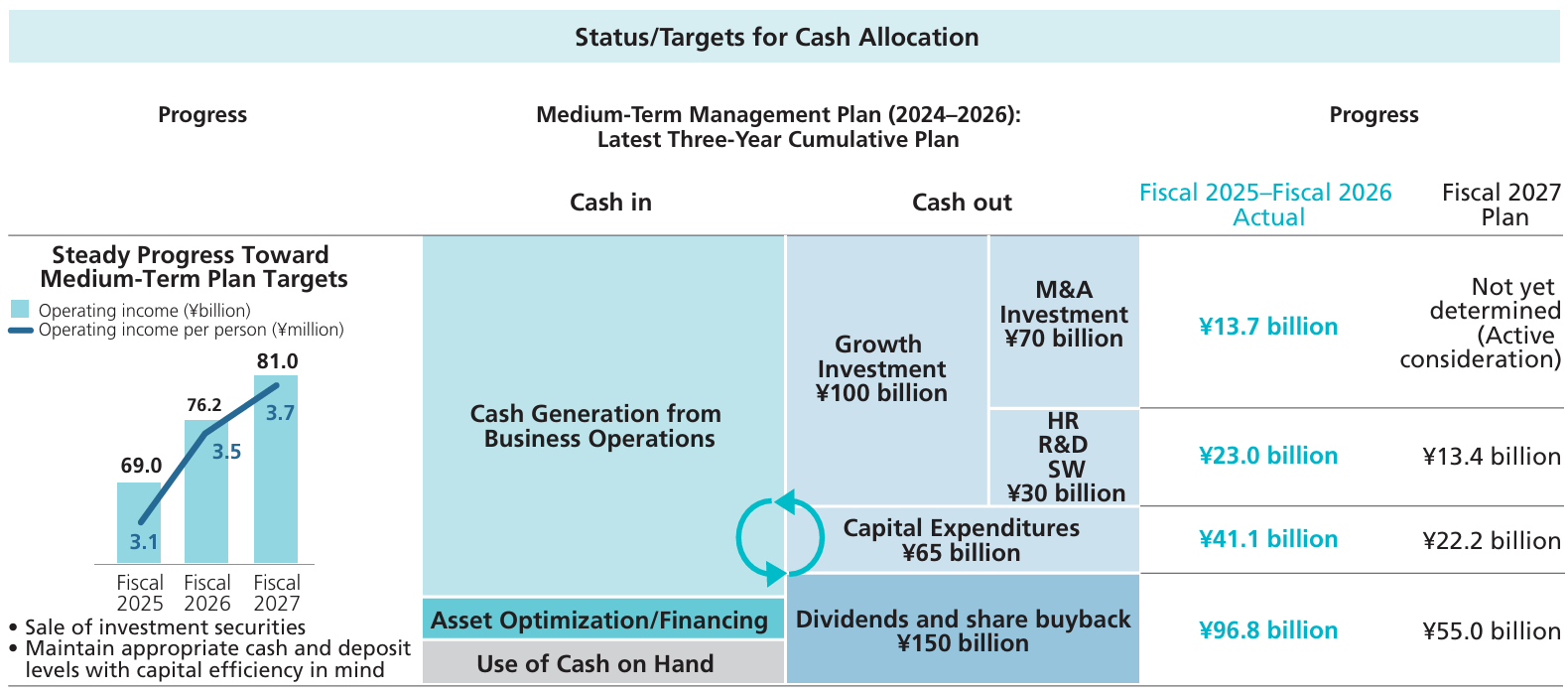
That said, investment timing and scale vary significantly from transaction to transaction, and it’s not our practice to evaluate progress from a spending perspective by prorating allocation evenly across a particular timeframe. Our investment budget was set at ¥70 billion over three years, and so far, we have allocated a total of ¥13.7 billion in the first two years. We don’t consider this to be an indication of delayed progress. Rather, our priority is on careful selection of investment targets with the potential for returns exceeding the cost of capital while maintaining investment discipline.
Also of note, while our proactive share buyback agenda in fiscal 2026 caused an increase in cash outflows to cover dividends and share repurchases, the funds used didn’t come from our growth investment budget but instead reflect the implementation of additional capital measures based on our balance sheet situation and market conditions. I believe flexibility is essential when implementing capital policy so as not to miss opportunities. With regard to cash allocation, the plan is to be flexible here as well, tapping an optimal amount for measures that will contribute to enhanced corporate value while taking into account our current cash position and financial condition.
With this in mind, we aim to strike a balance between growth investments, shareholder returns and financial discipline, and demonstrate our approach to cash allocation and practical implementation of associated measures through concrete results.
Q6.In closing, do you have a message for shareholders and investors?
We aim to create social and economic value through management guided by OUR PHILOSOPHY—the Group’s basic philosophy—and also contribute to a sustainable society and realize enduring improvement in corporate value.
I recognize—we all do—that fiscal 2026 was a year in which perceptions about TIS—and TISI—shifted amid changes in the market environment. Within this context, we have advanced initiatives to increase corporate value by hitting our performance targets, implementing agile capital policy, and then communicating our medium- to long-term growth strategy and engaging in dialogue to deepen understanding. These initiatives revolve around the core concept of a virtuous cycle: promoting integrated measures from both a business and financial perspective and using robust growth investments to fuel our cash-generating capacity, which leads to healthier shareholder returns. Going forward, our top priority is to steadily invest for growth, including investment in human resources, and to use the results gained to drive further growth and deliver higher shareholder returns. Cash allocation for enhancing corporate value is of the utmost importance. We will drive a scalable, sustainable and accelerated virtuous cycle with faster decision-making under the One Company management structure established through the merger that created TISI. Comments and opinions shared by shareholders and investors during dialogue opportunities have provided extremely valuable food for thought that we use to improve management practices. We have always considered stakeholder perspectives when making important decisions and taking action, and we will continue to do so in the future.
Market conditions have changed, and partly due to that, the market’s assessment of our corporate value doesn’t align right with our own view. But there have been times in the past when the market’s assessment demonstrated high expectations regarding our competitive advantages and growth potential. I believe the current situation leaves room for reevaluation, and we intend to regain market confidence by eliminating the discount and creating new competitive advantages and growth potential.
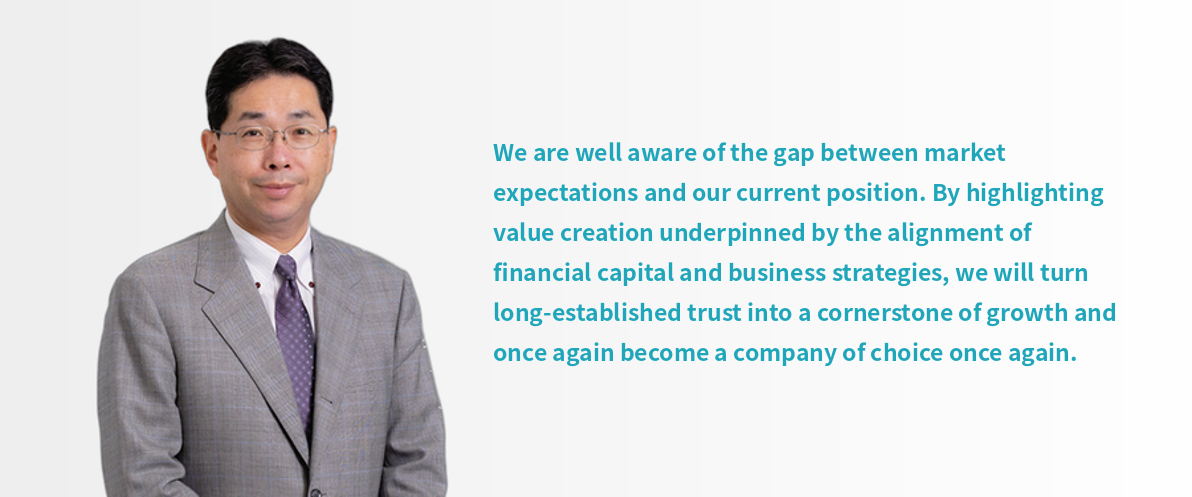
We will continue to engage in dialogue with stakeholders, using these opportunities as a touchpoint for presenting and explaining initiatives—our own and of the Group as well—and we will strive to meet expectations. Ultimately, we want to be recognized as a company that has the market’s trust and inspires confidence in a bright business future, and to remain a company of choice.
September 30, 2026
Masakazu Kawamura
Managing Executive Officer, Division Manager of Corporate Planning SBU