
Top Message (Integrated Report Version)
Q.How would you evaluate progress on the medium-term management plan?
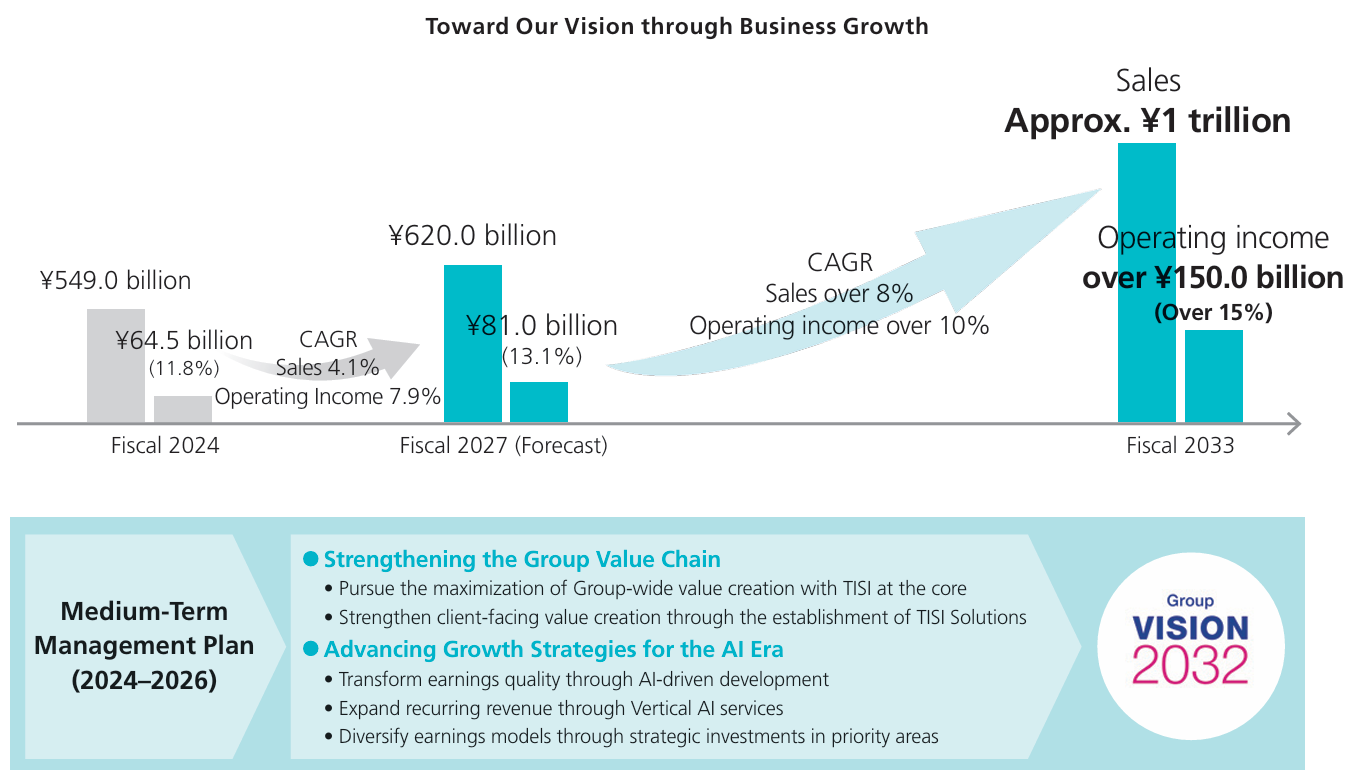
Fiscal 2027, ending March 31, 2027, is the last year of three-year Medium-Term Management Plan (2024–2026), and I would say progress is generally proceeding well. Achieving targets for key performance indicators is within sight, not only for net sales and operating income but also for ROE and EPS CAGR, and we have already hit the target for operating income per employee. Challenges do exist, in such pursuits as expansion of service-based businesses, but overall, efforts to date are steadily yielding results.
That said, the business environment is changing at a pace exceeding assumptions made when the medium-term management plan was formulated. The evolution of artificial intelligence (AI) in particular has created a situation where it’s not business as usual anymore. We can’t move on to the next stage of growth simply by extending initiatives already in play. Fiscal 2027 will therefore be a crucial run-up phase during which we will not only do our utmost to see the current medium-term management plan through to successful completion but also set the stage for a strong start to the next medium-term management plan. TISI, at the core of the TIS INTEC Group, will solidify the foundation for next-stage growth through the evolution of an AI-driven business model and an emphasis on strategic investments in key areas.
Q.The evolution of AI is bringing about major changes in the business environment and in market perceptions. What is your take on the current situation?
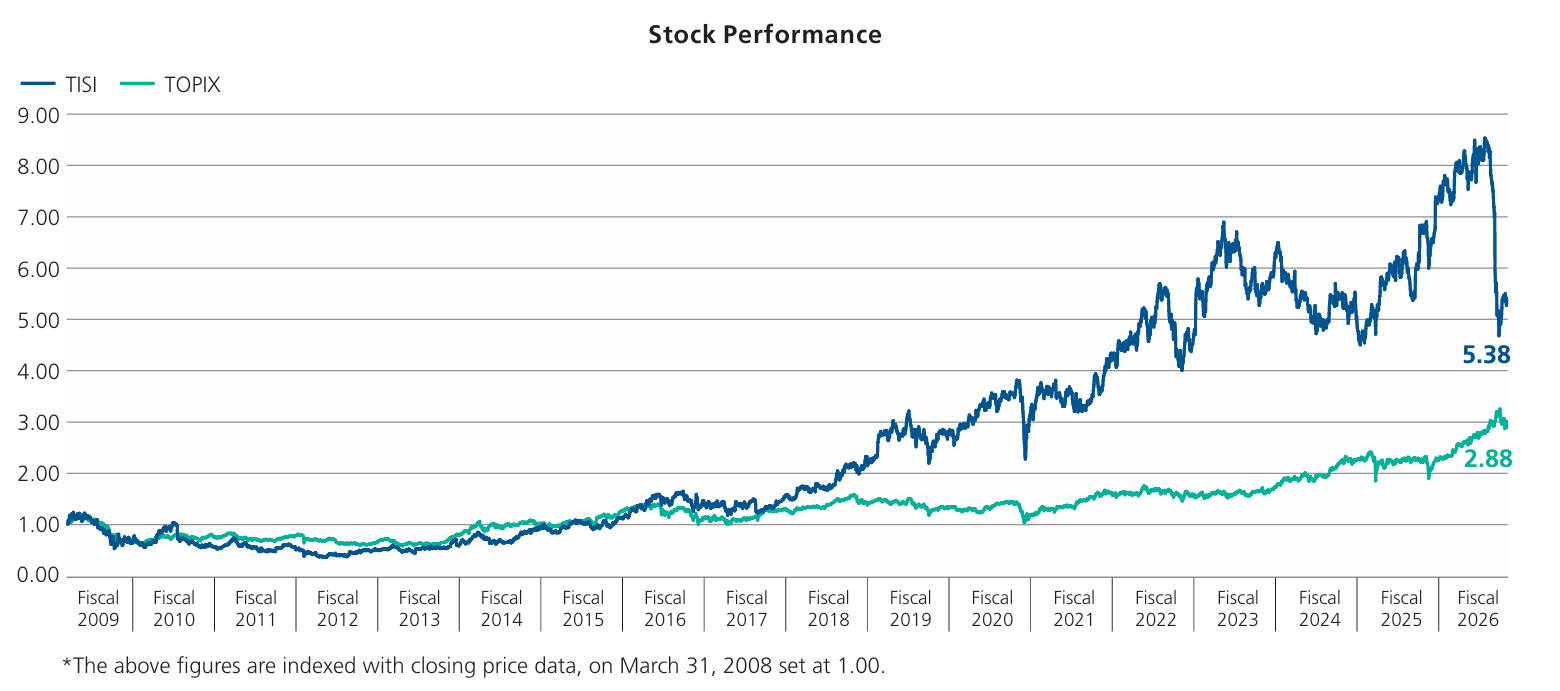
In early 2026, against the backdrop of AI’s rapid evolution, the position taken by capital markets regarding value proposition—the promise of value to be provided— as well as value delivered and growth prospects of companies in the IT services industry shifted dramatically from optimism to concern, and TISI was not immune to the inevitable impact on stock prices caused by changing market perceptions. Shareholders and investors joined a worried chorus, voicing concerns and harsh criticisms of their own, and we recognized this as a critical juncture that required us to demonstrate with greater clarity how TISI and the corporate group it leads would continue to grow in the age of AI.
To shareholders and investors, stock price is most certainly an important indicator for gauging corporate growth. While management decisions are not based solely on daily stock prices, it’s the responsibility of management at TISI, as executives of a publicly traded company, to outline a path to growth and present a track record of success to shareholders who have invested in our future potential and who have stood by us, with support and high hopes for success from a long-term perspective. To that end, the announcement about a decision made in March 2026 to repurchase treasury stock was the perfect opportunity to articulate management’s perspective on the Group’s medium- to long-term growth potential and intrinsic value.
Of fundamental importance, however, is for us to show just how much growth potential we have, because it’s this information that capital markets are so eagerly awaiting. From shareholders and investors, comments indicate concern that AI might diminish the value of system integrators’ work and usurp existing system development demand. But we see this sentiment stemming in part from our own inability to fully communicate the nature of the Group’s businesses and the underlying potential for growth even in the age of AI.
AI significantly improves the efficiency of programming work, but being able to write programs and being able to build and operate mission critical systems are completely different things. The ability to design, implement and operate systems that support our clients’ core business activities—safely, reliably and aligned with overall operations—is and will remain necessary. If anything, the value of our expertise as a system integrator to design an entire system, guarantee its quality and maintain it on an ongoing basis is increasing precisely because companies are so keen these days to integrate AI into business processes.
We will use AI-driven changes as fuel to create new value propositions and enhance revenue models, and we will continue to actively communicate Group philosophy and strategic direction.
Q.How will AI contribute to growth of the Group?
We aim to utilize AI in two main ways. One is to integrate AI into our development processes to improve productivity, quality and profitability. And the other is to integrate AI into clients’ business processes to enhance the value we deliver to clients. First, regarding our own development processes, we are already moving toward AI-driven system development. In new system development, we augmented the capability of AXION, a proprietary development platform, with AI tools, and confirmed a 47% improvement in productivity on select projects. In addition, in the area of maintenance development, we created Agentic RAG, a project-dedicated chat system incorporating project-specific information, and have initiated verification tests at the client project level. We are also promoting the use of AI in project management and quality control activities and consequently seek to boost development productivity by 50% by fiscal 2030.
We will redirect resources freed up by AI-driven development toward business activities that generate higher added value. AI may change the way we develop systems, but ultimately responsibility for ensuring quality and delivering value to clients lies with humans. Turning to the second objective—the value we deliver to clients—simply introducing AI into individual business processes isn’t going to be enough to achieve the desired results. Integrating AI into a company’s mission-critical operations—its core activities—safely and effectively requires a holistic view of the entire business and a strategy to identify which AI technology will best enhance which business or operational process and what data to utilize, and how to ensure safety and quality. This is precisely where we, as a system integrator, can demonstrate our strength in solution design. Rather than use AI as a standalone tool, we will increase the value we deliver to clients by providing AI-driven solutions that work effectively within client operations.
Q.In the age of AI, how will you leverage industry and business insights and expertise in mission-critical systems to secure a competitive advantage?
Our industry and business insights and our expertise in mission-critical systems are vital in converting growth opportunities in the age of AI into competitive advantages unique to our corporate group. For agentic AI to deliver value, it must interact with client-side business data and mission-critical systems. The challenge lies not in the introduction of surface-level AI tools but in how best to transform key business processes with AI technology and translate such changes into lasting results.
Through extensive involvement in projects for a diverse client base, we have gained a keen understanding of business processes across a wide range of industries and sectors, including finance, manufacturing, the public sector, payment settlement and networking, enabling us to amass extensive knowledge and build a proven track record. In the payments sector in particular, we have a long history of supporting mission-critical systems. We will roll out Vertical AI services offered nowhere else but from TISI and the Group it leads by combining accumulated industry and business sector knowledge and expertise in mission-critical systems with AI.
Our strategy for helping clients utilize AI in their operations highlights three approaches.
The first is to develop and deliver AI-powered services in areas where TISI and companies under the Group umbrella enjoy a competitive advantage. Cashless payments and networking are examples of areas where in-depth knowledge and years of experience enable us to identify industrywide challenges and quickly provide solutions in the form of standardized services. In January 2026, we launched an AI fraud detection service for international credit cards. Going forward, we will continue to integrate AI into forte fields and provide services closely tailored to clients’ day-to-day business practices.
The second approach is to build AI-powered systems matched to the business operations of client companies. We are integral to the successful performance of clients’ mission-critical systems, having the ability to design the appropriate architecture and identify the areas that would most benefit from AI, based on our understanding of the big picture. Xenlon Modernization Service, from TISI, also serves as a key client touchpoint, promoting wider involvement in areas related to mission-critical systems through modernization of legacy systems and then subsequent adoption of AI.
The third approach is on-site client support. This goes beyond simply handling programming work at client offices. We have built trust with our clients through close interaction on projects and a deep understanding of their business processes and the issues they face. Such trust is a major competitive advantage when tasked with integrating AI into client operations.
An issue that will become increasingly important with wider use of AI is the proliferation of individual AI systems without adequate oversight. The more AI is used for local optimization, the greater the potential for overall inefficiency and increased security risk. Our ability to design and deliver practical, real-world solutions to such issues from a holistic optimization perspective is our true strength, honed through many years of developing mission-critical systems. We will not limit the use of AI merely to improve efficiency, but rather leverage AI as a mechanism to continuously support client-side business transformation, which will translate into unique competitive advantage and expanded recurring revenue streams.
Q.What is the significance of TIS and INTEC merging at this time to form TISI?
With the merger of TIS and INTEC on July 1, 2026, we marked a new beginning as TISI Inc. Historically, both companies reinforced existing operations as part of the same corporate group following the establishment of IT Holdings Corporation through management integration in 2008, drawing on distinctive characteristics to hone respective strengths. Later, both companies promoted unified group management and demonstrably reinforced quality control and business collaboration. But there was, I must admit, still room for improvement, especially in maximizing synergies between TIS and INTEC.
For example, by combining TIS’ expertise in large-scale core system development with INTEC’s expertise in on-site client support, value provided to TIS’ clients would certainly rise. From the INTEC perspective, TIS’ development capabilities and services—notably, payment settlement—could be brought to INTEC’s client touchpoints.
The merger of TIS and INTEC into TISI as “One Company” will remove the barriers that previously existed between the two companies. Through rapid decision-making and unified business operations, we will consolidate business strengths cultivated separately by TIS and INTEC and create a structure better positioned to deliver value to clients across all business areas. Today, as AI drives demand for business transformation among client companies, our enhanced ability to provide multifaceted support that brings together core systems, on-site client support, networking, payment settlement and service-based businesses carries significant weight.
A key component of success here is something I call “buddy power”—essentially, “strength as a team.” The merger has enabled “teammates” with different capabilities to connect on a deeper level and take on challenges in areas that would have been daunting to tackle alone. I believe that pooling our respective insights, client touchpoints, services and technologies to generate greater value across the client base is the very essence of the evolution of buddy power at TISI.
Through the launch of TISI, we aim to achieve far-reaching synergies throughout the Group. Instead of simply adding up sales and income generated in each business unit, we will raise overall growth potential by leveraging the strengths of one business unit to serve a different sphere of clients and by introducing new services to the client touchpoints of other business units. These initiatives will help us define new business models for the age of AI.
Q.How will strategic investments in key areas help to diversify revenue models?
Systems integration is the cornerstone of the Group’s business foundation and will continue to evolve. But even if we could achieve stable growth with traditional systems integration alone, the business would be limited in its capacity to accelerate growth. Consequently, we will diversify our revenue models by introducing additional service-based solutions and businesses in which we are directly involved in operations through co-creation initiatives and the pursuit of M&A. The objective of this approach is to expand the IT & Business Offering Service (IOS) and Co-Creation Business (CCB) in particular, two of the four strategic domains highlighted in Group Vision 2032. In the age of AI, we will continue to shift toward a service-oriented model in areas where we already have a competitive edge and at the same time incorporate insights gained in new business areas while leveraging co-creation with partners, strategic investments and M&A opportunities.
An example of this process is Nihon ICS Co., Ltd., a provider of accounting and tax-filing packages to tax accounting offices and the clients they advise, which then-TIS turned into a consolidated subsidiary in April 2023. This expanded our business into tax and accounting, and gave us a new client base of tax accounting offices and their clients. By incorporating AI into these operations, the company will sharpen the competitiveness of its services and improve profitability.
Another example is RESCHO, INC., a provider of electronic medical record software solutions fine-tuned for use by psychiatry professionals, which came under the Group umbrella in December 2023, reinforcing our healthcare IT and medical DX platforms.
Under the next medium-term management plan, we will focus attention on areas with major potential for transformation through AI—such as payment settlement, where we maintain a strong presence, as well as healthcare, where strategic investments have strengthened our business foundation—and establish revenue models for pursuits that go beyond traditional system integration.
Q.How will the workforce and organizational capabilities change as you implement the TISI strategy for future growth?
Even in the age of AI, people will always be the source of value creation and competitive advantage. What will change, however, are the roles employees are expected to play—and significantly so. Tasks that can be handled by AI will be delegated to AI, thereby freeing personnel to focus on areas that generate higher added value. This will be our basic concept for human resources and structural change going forward.
It will be crucial for all employees to be AI-literate, understand the characteristics of each AI system, and have the ability to determine which business operations would benefit from AI and how to apply the associated system effectively. Regardless of the department where employees work, be that development, operation, sales or administration, they will have to possess the ability to integrate AI into their work to boost productivity and provide greater value.
That said, even as AI continues to evolve, there will always be roles that require people to fill. In fact, the ability to understand our clients’ business operations and management challenges, visualize what needs to be changed, and formulate solutions through discussions with stakeholders will become more important than ever. Employees closest to clients—the business frontline— take on the roles that AI doesn’t cover. A particular priority for me since becoming president has been to strengthen our frontline, and I believe a robust frontline will acquire greater significance in the age of AI. Going forward, we will focus on developing and deploying talent with the ability to address client issues on the frontline, talent responsible for creating new businesses, and cross-functional IT talent utilizing multiple IT skills to design comprehensive solutions.
In conversations with shareholders and investors, I often share this analogy: When a car manufactured using factory automation breaks down, it’s people who identify the cause, disassemble the vehicle and repair it, and thereby ensure quality. The same holds true for IT. Only when people correctly understand what AI has generated and can guarantee quality will we earn client trust and fulfill our social responsibilities. Utilizing AI to expand human potential and enabling diverse talent to connect organically to create value will lead to competitive advantage. We will accelerate strategic investment activity, including talent development, to realize this.
In terms of organizational capabilities, we will promote unified business operations centered on TISI and evolve into a corporate group capable of delivering optimal value across the Group’s client base. We will increase the collective value of the Group by applying insights cultivated and services provided in one area to other clients and other business areas. This approach must take root within our corporate culture.
By simultaneously leveraging AI to improve productivity and shifting freed-up assets to high-value-added areas where human involvement is essential, we will ensure the effectiveness of our growth strategy and realize tangible results, including higher operating income per employee.
Q.How will the foundation built under the current medium-term management plan and future changes lead to sustainable improvement in corporate value?
The real test from here on is whether the foundation we have built under the current medium-term management plan is sufficient to drive sustainable growth. We will leverage a combination of factors—namely, the evolution of AI, the merger of TIS and INTEC, and strategic investments in select areas—to enhance productivity on a groupwide basis and increase the value we provide to our clients. The cumulative effect will fuel growth more robust than ever before and, keeping in mind numerical targets—consolidated net sales of about ¥1 trillion and consolidated operating income exceeding ¥150 billion by fiscal 2033—that demonstrate our corporate aspirations, lead to sustainable improvement in corporate value, which is a goal we share with our stakeholders.
The key is to steadily implement stated strategies to a successful end. We are committed to engaging sincerely with our clients, earning their appreciation, and translating that into better business results. By carefully building on these efforts, one following another, we will enhance the growth potential of the Group.
One of the biggest achievements I’ve seen in the past five years since becoming president in April 2021 is that executives and employees are thinking more for themselves and taking greater initiative instead of simply waiting for instructions from upper management. When we formulated the current medium-term management plan, some aspects were perhaps too ambitious for the Group to achieve as it stood at that time. We communicated to shareholders and investors the difficulty of reaching certain targets by simply continuing along the same path as before. Happily, however, the Group worked as a cohesive unit, promoting unified measures, and we are now within sight of even those challenging goals.
This experience served to reinforce my already strongly held belief—that without dreams and a vision, people can neither aim for great heights nor reach them. For exactly this reason, I feel my most important job as president of TISI is to articulate the vision and goals that the Company, and by extension, the Group, seeks to achieve, take the lead on this journey, and maintain a fighting spirit no matter what changes occur in the business environment.
The numerical targets stated above that reflect the size and scale of the corporate group we seek to be are by no means easy to achieve. Nevertheless, I believe my role is to use the launch of TISI as an opportunity to grow our corporate group into a stronger, more sophisticated organization and then pass the leadership baton on to the next generation.
I hope all stakeholders, including shareholders and investors, will see the bright future that is sure to come as efforts to realize sustainable growth and enhance corporate value bear fruit, and I ask for your continued support.
September 30, 2026

Representative Director, President and Executive Officer